
You wake up and your neck feels like it has been locked overnight. Turning to look at the clock is a small battle. By the afternoon, the stiffness has settled into a dull ache across your shoulders, and by evening it feels like you’re carrying a bag of bricks on your neck. You rub it, stretch it, and promise yourself you’ll “do something about it soon.”
If this sounds familiar, you’re in very large company. Neck pain is one of the most common complaints I hear, and it has become much more common as phones, laptops and long desk hours have taken over our days. The good news is that most neck pain is mechanical and can be improved with simple changes. Let me explain what is usually going on.
What neck pain and stiffness actually feel like
For some people it is a stiff, tight neck that won’t turn fully to one side. For others it is a deep ache at the base of the neck that creeps into the shoulders and between the shoulder blades. Some feel a burning or pulling along the back of the neck after a long day. Others get a headache that starts at the back of the head and travels forward.
It may come and go, or it may stay with you for weeks. Many people first notice it first thing in the morning, or after sitting at a screen for hours. Some feel it spread into one shoulder or down the arm, which is worth paying attention to, and I’ll come back to that.
Why it happens: the common causes
Your head weighs roughly four to five kilograms. When it sits balanced over your spine, your neck carries that weight easily. But when you bend your head forward to look at a phone, the load on the neck muscles and joints multiplies. Over hours and days, that adds up.
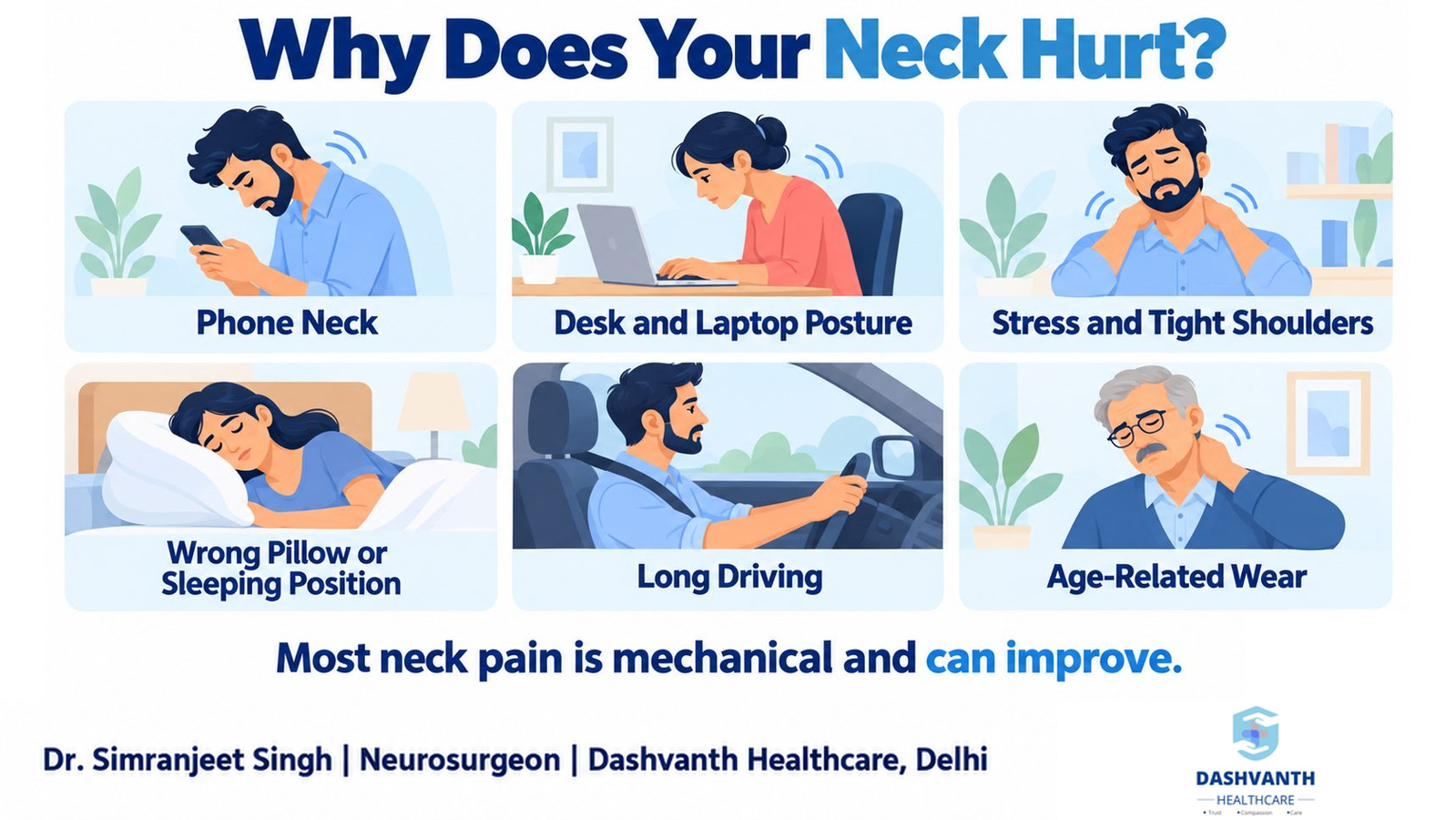
The “phone neck” habit. Looking down at a phone for long stretches, especially in bed or while commuting, keeps your neck bent forward. The muscles at the back of the neck are working all the time to hold your head up, and they get tired and tight.
Desk and laptop posture. A laptop on a table pulls your eyes down and your head forward. A chair without back support makes your shoulders round. Together, they strain the neck and upper back.
Stress. When you’re tense, you lift your shoulders without noticing. Stress and long working hours keep the muscles around the neck in a constant state of tightness.
Sleeping position and pillow. A pillow that’s too high, too flat or too hard can leave the neck bent all night. Sleeping on your stomach with your head turned is another common cause of morning stiffness.
Long driving and travel. Hours behind the wheel, with the neck held forward and the shoulders tense, often end in a stiff neck.
Sudden movements or strain. A jerk, a sudden turn, or lifting something heavy can strain the neck muscles.
Age-related wear. As we get older, the cushions between the bones of the neck wear down gradually, and the joints can become stiff. This is a normal part of ageing, and many people with these changes have little or no pain.
How it disrupts everyday life
Neck pain rarely stays in the neck. It slips into the rest of your day.
At your desk, you catch yourself leaning toward the screen, with your shoulders creeping up toward your ears. The ache builds, and it becomes hard to concentrate on anything else.
On the phone, you scroll for a few minutes and suddenly your neck is complaining. Texting, reading and watching videos have all become uncomfortable, and many people feel they can’t put the phone down but also can’t hold it comfortably.
While driving, turning your head to check a blind spot or reverse becomes painful or limited. Some people find themselves turning their whole body instead, which is tiring and unsafe.
At night, finding a comfortable position becomes a puzzle. You wake up stiff, and the day starts with discomfort rather than energy.
Even simple things, like washing your hair, looking up at a shelf, or carrying a heavy bag on one shoulder, can bring the pain back.
What helps, and what to avoid
Most people can improve a great deal with a few practical changes.
What to do:
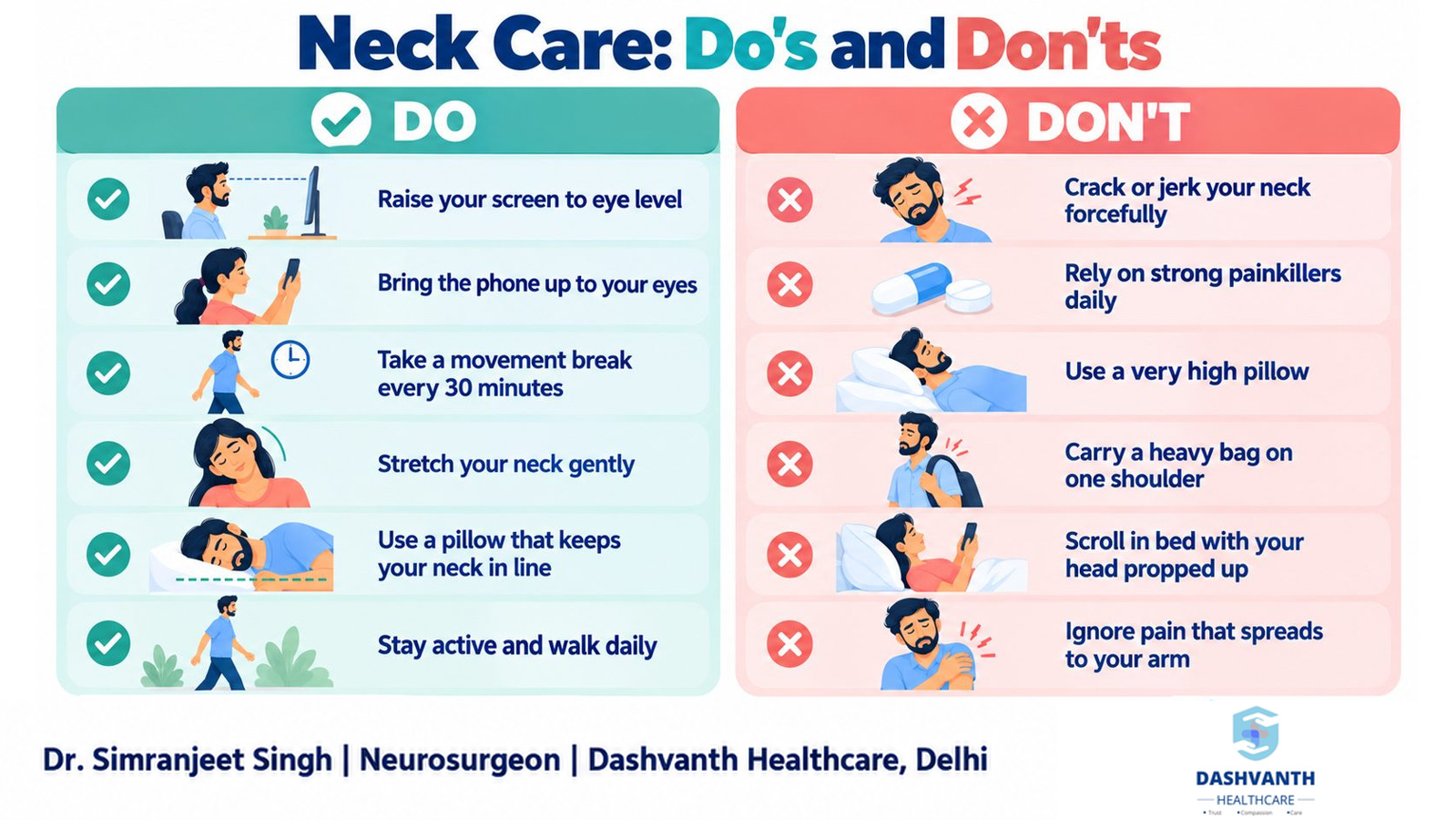
- Raise your screen to eye level. For a laptop, use a stand or a pile of books and a separate keyboard if you can.
- Bring your phone up to your eyes instead of bending your neck down to it. Rest your elbows on a table or your lap.
- Sit with your back supported, your feet flat, and your shoulders relaxed rather than hunched.
- Take a movement break every 30 to 40 minutes. Stand up, roll your shoulders back, and look out of a window.
- Do gentle neck stretches a few times a day. Slowly bring your ear toward your shoulder on each side, and slowly turn your head left and right. Move gently and stop if it hurts.
- Apply a warm compress or take a warm shower to ease stiffness. For a fresh strain, a cold pack for the first day can help.
- Choose a pillow that keeps your neck in line with your spine, not bent up or down. If you sleep on your side, the pillow should fill the gap between your ear and the shoulder.
- Walk regularly and stay active. Movement is good for neck health.
- Manage stress through breathing, short breaks, enough sleep, or whatever helps you unwind.
What not to do:
- Don’t crack or jerk your neck forcefully, and avoid roadside or untrained “neck adjustments”.
- Don’t rely on strong painkillers every day to get through the pain. If you need them regularly, see a doctor.
- Don’t use a very high or very thick pillow, or sleep on your stomach with your neck twisted.
- Don’t carry a heavy bag on one shoulder.
- Don’t scroll in bed with your head propped up awkwardly.
- Don’t ignore pain that keeps getting worse, or pain that travels into your arm.
- Don’t rest completely for days. Gentle movement helps recovery more than staying still.
When it’s time to see a neurosurgeon
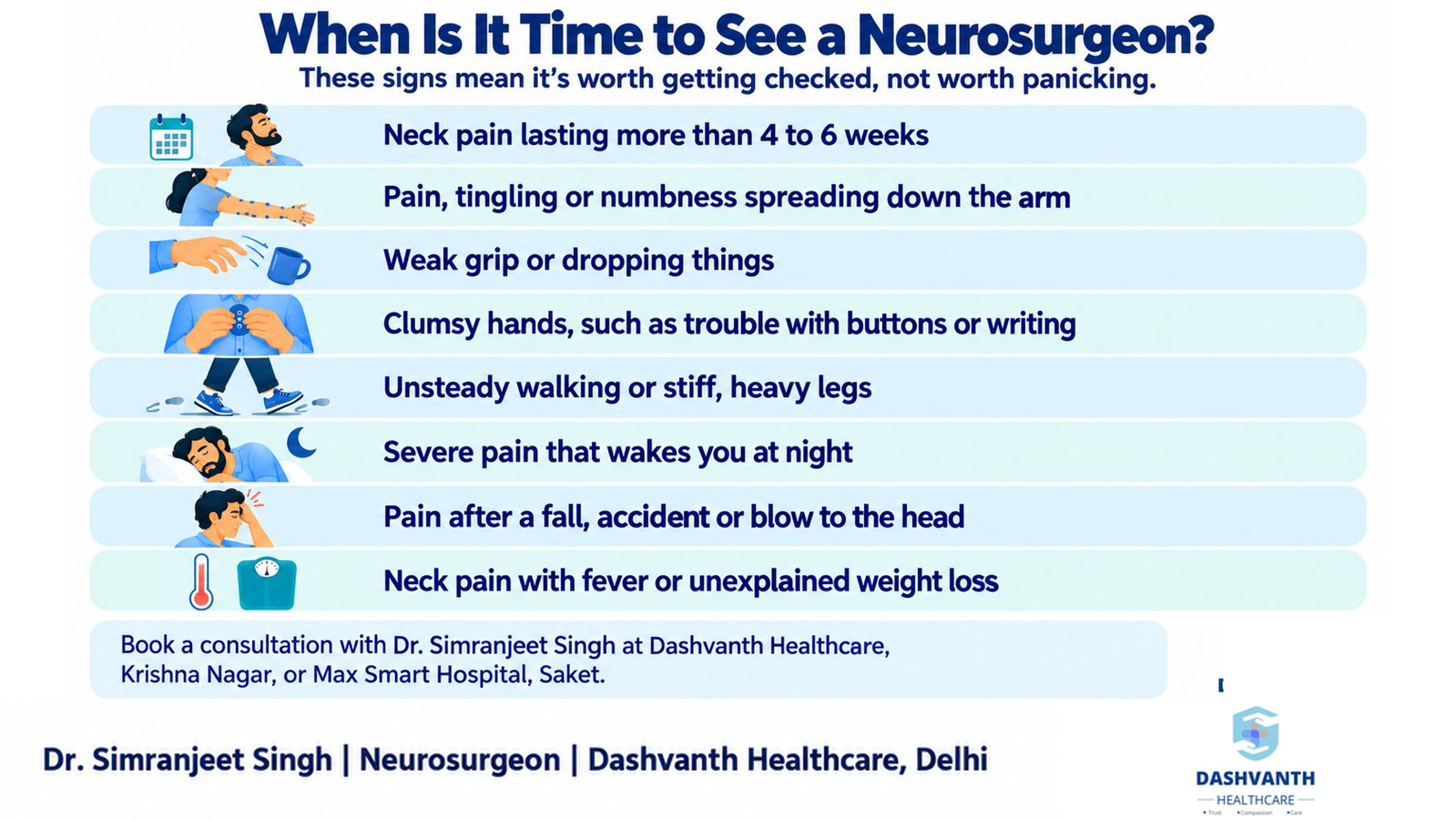
Most neck pain settles with the steps above within a few days to a few weeks. But the neck also carries the spinal cord and the nerves that serve your arms and hands, so some signs are worth getting checked properly. Please book a consultation if:
- Your neck pain has lasted more than four to six weeks despite sensible changes.
- Pain, tingling or numbness spreads down one or both arms into the hands or fingers.
- You notice weakness in your hand or arm, a weak grip, or you drop things more often.
- Your hands feel clumsy, for example when buttoning a shirt or writing.
- You feel unsteady while walking, or your legs feel stiff or heavy.
- The pain is severe, keeps you awake at night, or is getting steadily worse.
- Your neck pain began after a fall, accident or blow to the head or neck.
- You have neck pain along with fever, unexplained weight loss, or you feel generally unwell.
These signs do not mean something serious is certain. They simply mean a proper examination, and sometimes a scan, will tell us exactly what’s happening, and the earlier we know, the more simply it can usually be managed.
A word about getting help
If your neck pain is not settling, or you’re not sure whether what you feel is the ordinary kind, you don’t have to wait it out. At Dashvanth Healthcare in Krishna Nagar, Delhi, and at Max Smart Super Speciality Hospital in Saket, I see patients with neck and spine problems as well as conditions of the brain and nerves. We’ll listen carefully, examine you, explain what we find in plain language, and guide you toward the simplest treatment that works, whether that’s posture changes and exercises or something more.
Your neck holds up your head all day, every day. Give it a little care in return: lift your screen, relax your shoulders, move often, and listen when it asks for help.
Dr. Simranjeet Singh
M.Ch. Neurosurgery (AIIMS, New Delhi)
Director, Dashvanth Healthcare, Delhi.
Consultant Neurosurgeon, Max Smart Super Speciality Hospital, Saket.
This article is for general education and does not replace a personal medical consultation.