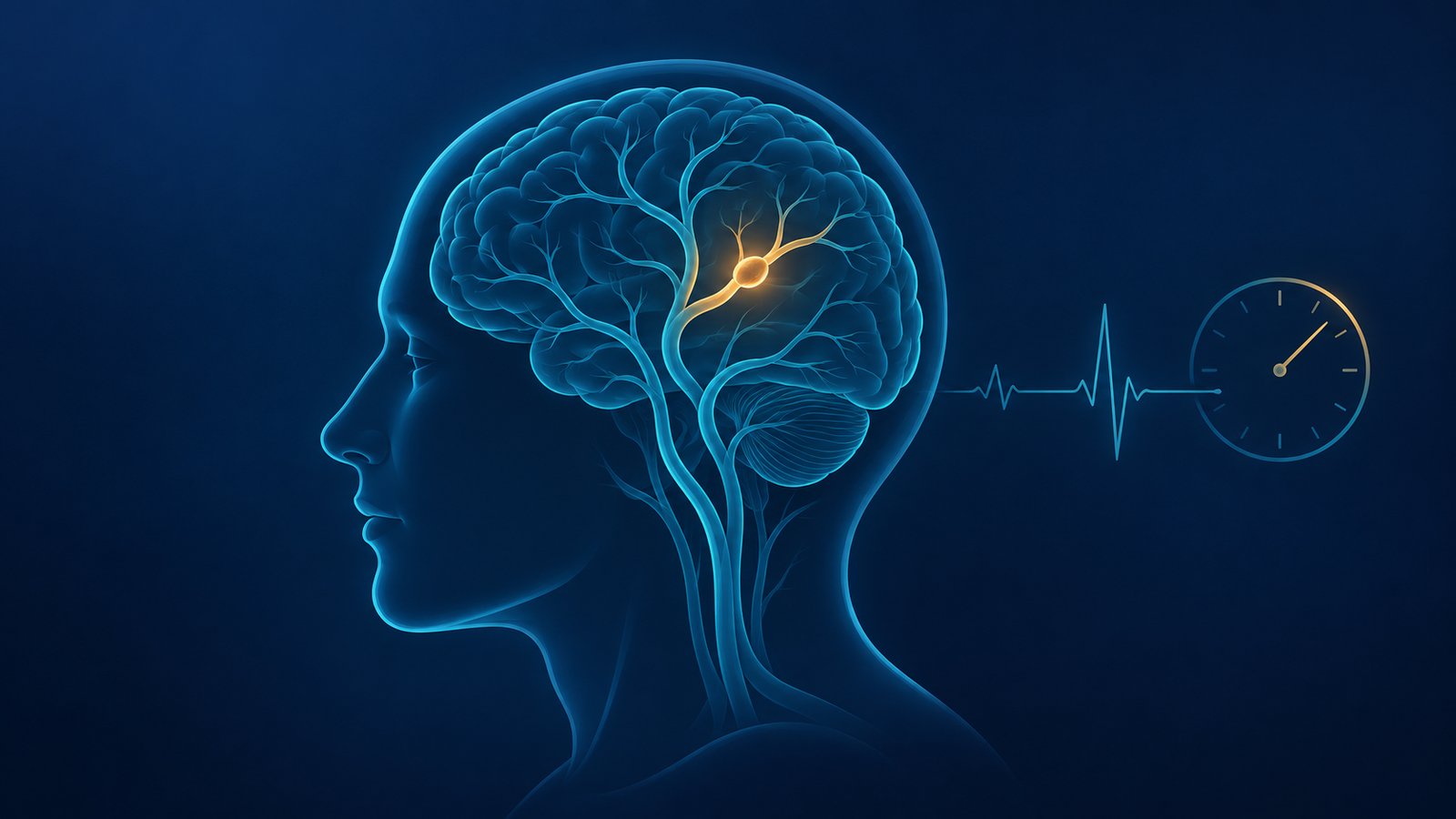
It rarely looks like what people expect. There’s no dramatic collapse, no clutching at the chest, no warning shout. Most strokes happen quietly, mid-sentence, mid-meal, mid-step — a hand that suddenly won’t grip a coffee cup properly, a word that comes out wrong, a face that feels heavy on one side. The person having it often doesn’t realize anything serious is happening. They might think they slept awkwardly, or that they’re just tired, or they’ll brush it off and try to keep going. That hesitation — the “let’s just wait and see” — is the single most dangerous part of a stroke, because it’s the part that costs the most time.
I’ve spent enough years treating strokes to know that the gap between symptom onset and hospital arrival is often decided not by ambulances or traffic, but by whether the people in the room recognized what they were looking at in the first place. That recognition is really the whole point of this piece.
Why it happens
A stroke is what happens when blood flow to part of the brain is suddenly cut off or a blood vessel in the brain ruptures. Brain cells need a constant supply of oxygen and glucose, and without it, they start dying within minutes — which is why speed matters so much more here than in almost any other medical emergency.
Most strokes — roughly four out of five — happen because a clot blocks a blood vessel supplying the brain, cutting off circulation to that area. This is called an ischemic stroke. The clot can form locally in a narrowed artery, often from years of high blood pressure, high cholesterol, diabetes, or smoking damaging the vessel walls, or it can travel up from elsewhere in the body, commonly the heart, especially in people with irregular heart rhythms like atrial fibrillation. The remaining strokes are hemorrhagic — a blood vessel in or around the brain bursts, usually because of long-standing uncontrolled high blood pressure, an aneurysm, or a vessel weakened by age. Both types are medical emergencies, and from the outside, they can look identical, which is exactly why treatment always starts with getting to a hospital immediately rather than trying to guess which one it is.
How it shows up — and why the moment is easy to miss
This is what makes stroke different from almost every other condition I write about. It doesn’t build gradually over days or weeks. It happens in the middle of an ordinary moment — while someone is driving, cooking, watching television, or asleep and waking up already affected. And because it often doesn’t come with pain, people underestimate it.
The most reliable signs, and the ones worth actually memorizing, follow a simple pattern doctors call FAST. Face: one side may suddenly droop, or a smile comes out lopsided. Arm: one arm may feel weak or numb, and when both arms are raised, one drifts downward without the person being able to stop it. Speech: words may slur, come out garbled, or the person may struggle to find simple words or understand what’s being said to them. Time: if any of this happens, the time matters more than anything else — note when it started and get emergency help immediately.
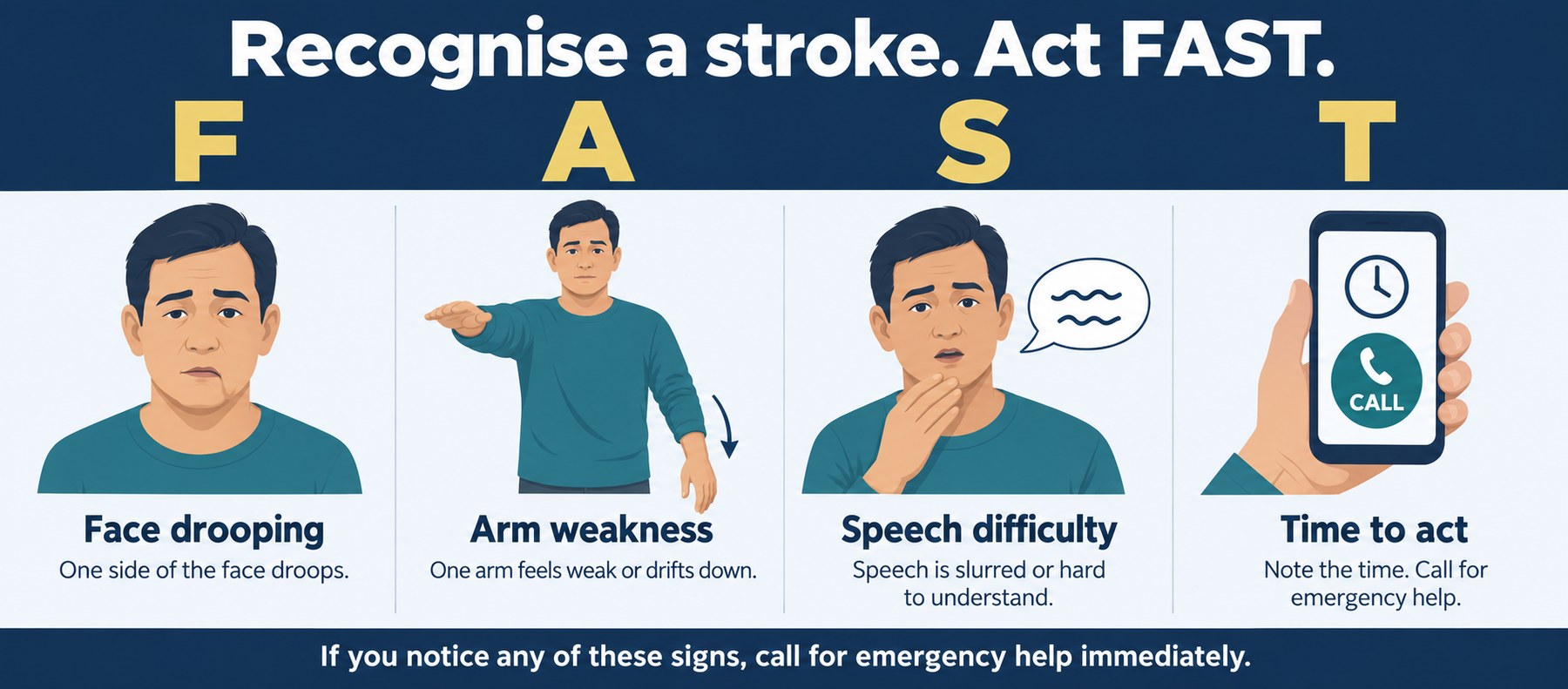
Beyond FAST, other signs can include a sudden, severe headache unlike any before it, sudden vision loss or double vision in one or both eyes, sudden dizziness or loss of balance and coordination, or sudden confusion. What ties all of these together is the word “sudden.” Symptoms that build slowly over days are far less likely to be a stroke; symptoms that appear in an instant, mid-activity, deserve immediate attention.
What to do — and what not to do
What to do: call for emergency medical help immediately — do not wait to see if symptoms pass, even if they seem to be improving. Note the exact time the symptoms started, since this single piece of information directly affects what treatments are available; clot-dissolving medication and clot-retrieval procedures both have time windows, and the earlier a patient arrives, the more options exist. Keep the person still, lying down with their head slightly elevated if possible, and stay with them, speaking calmly. If they lose consciousness, place them on their side to keep their airway clear.
What not to do: don’t drive the person yourself if an ambulance is available — paramedics can begin certain assessments and treatments en route, and hospitals are often alerted in advance so a stroke team is ready on arrival. Don’t give the person food, water, or any medication, including aspirin, since this can complicate treatment depending on the stroke type. Don’t wait to “see if it gets better” — some strokes do produce brief symptoms that resolve on their own, called a TIA or mini-stroke, but this is not a reason to relax; it’s often an early warning of a larger stroke to come within days, and it needs the same urgent evaluation.
Why every minute counts
This isn’t a section about warning signs that something might be serious — with stroke, every one of the signs above is already the signal. The phrase doctors use is “time is brain”: for every minute a stroke goes untreated, the average patient loses about two million brain cells. That’s the entire reason this piece is framed around speed rather than a gradual checklist of when to worry.
The encouraging part is that stroke treatment has changed enormously. Patients who reach a hospital within the treatment window have real options — clot-dissolving medication, and for certain large-vessel blockages, a procedure to physically remove the clot — that can dramatically change outcomes and, in many cases, reverse symptoms that looked severe at onset. None of this works if the first hour is lost to uncertainty about whether what’s happening is “really” a stroke.
If you or someone around you experiences any of these symptoms suddenly, treat it as an emergency and act immediately — that single decision, more than anything a hospital does afterward, is what protects long-term recovery. I see stroke patients both acutely and during recovery at Dashvanth Healthcare in Krishna Nagar and as a consultant at Max Smart SuperSpeciality Hospital in Saket, and the pattern is consistent every time: the families who recognized the signs early and moved fast are the ones who tell me, months later, how much of a difference those first minutes made.