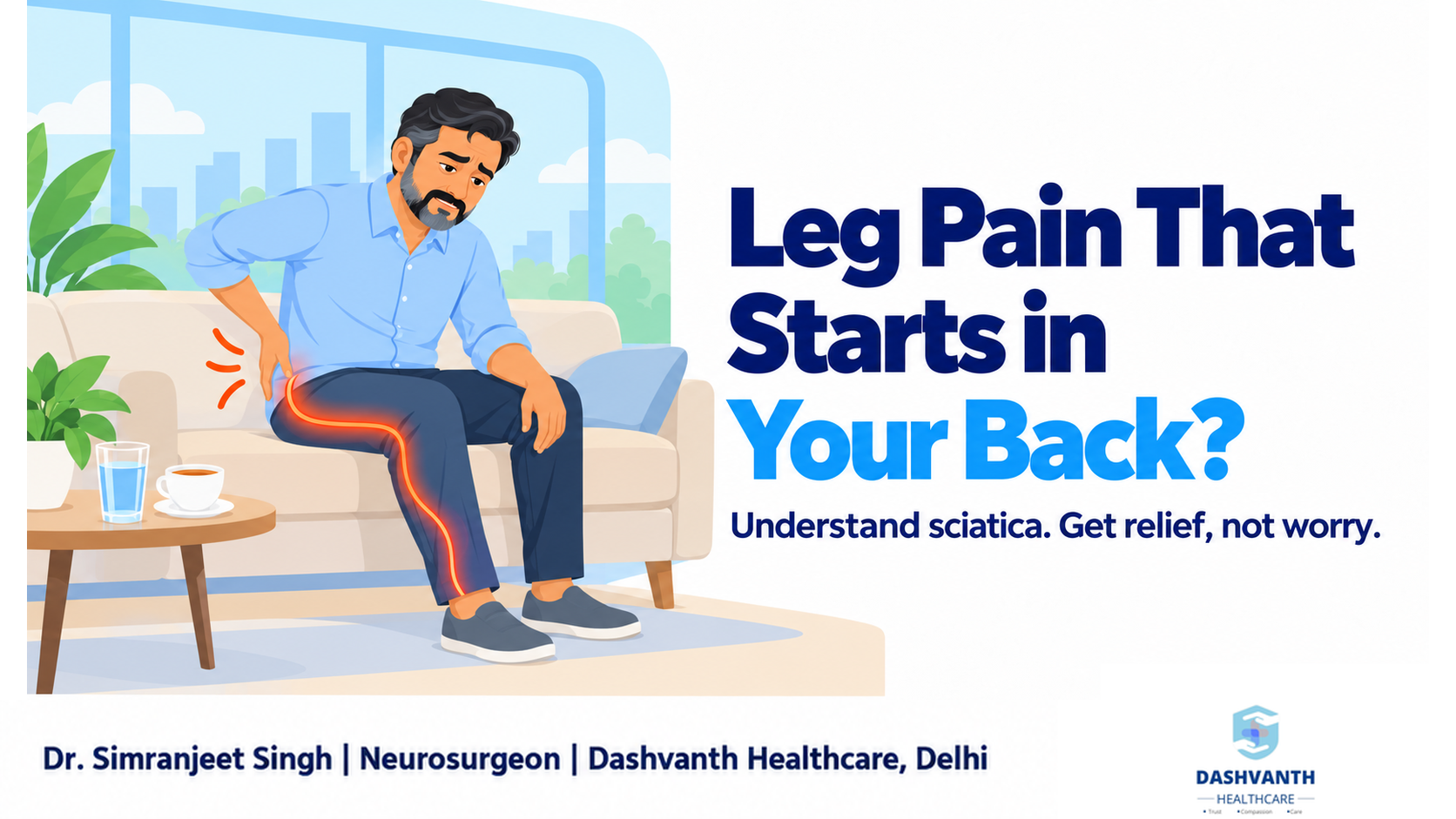
People describing sciatica often say things like, “There’s a pain that starts in my lower back, runs down the back of my thigh, and sometimes reaches my calf or foot.” Some describe it as a burning line. Others feel an electric zing, a deep ache, or pins and needles. Often it affects only one leg.
Many people also find the leg hurts more than the back does. Some say the foot feels heavy or “asleep.” Others notice the pain shoots down when they cough, sneeze, or bend forward to tie a shoelace.
If this sounds familiar, you’re far from alone. Sciatica is a common reason people seek medical advice, and the NHS notes that it often improves on its own within weeks to months. If your main problem is back pain without leg symptoms, our article on back pain and what helps may be a better starting point.
What is happening inside your body?
You have a thick nerve called the sciatic nerve. It is made from several smaller nerves that leave your spine in the lower back, join together, and travel through the buttock and down the back of each leg. Think of it as a long electrical cable running from your lower spine to your foot.
Sciatica is not a disease by itself. It’s the name for the pain you feel when something irritates or squeezes one of the nerve roots that form this cable. The pain shows up along the path of the nerve, which is why a problem in your back can be felt in your leg or foot.
Common causes, in simple words
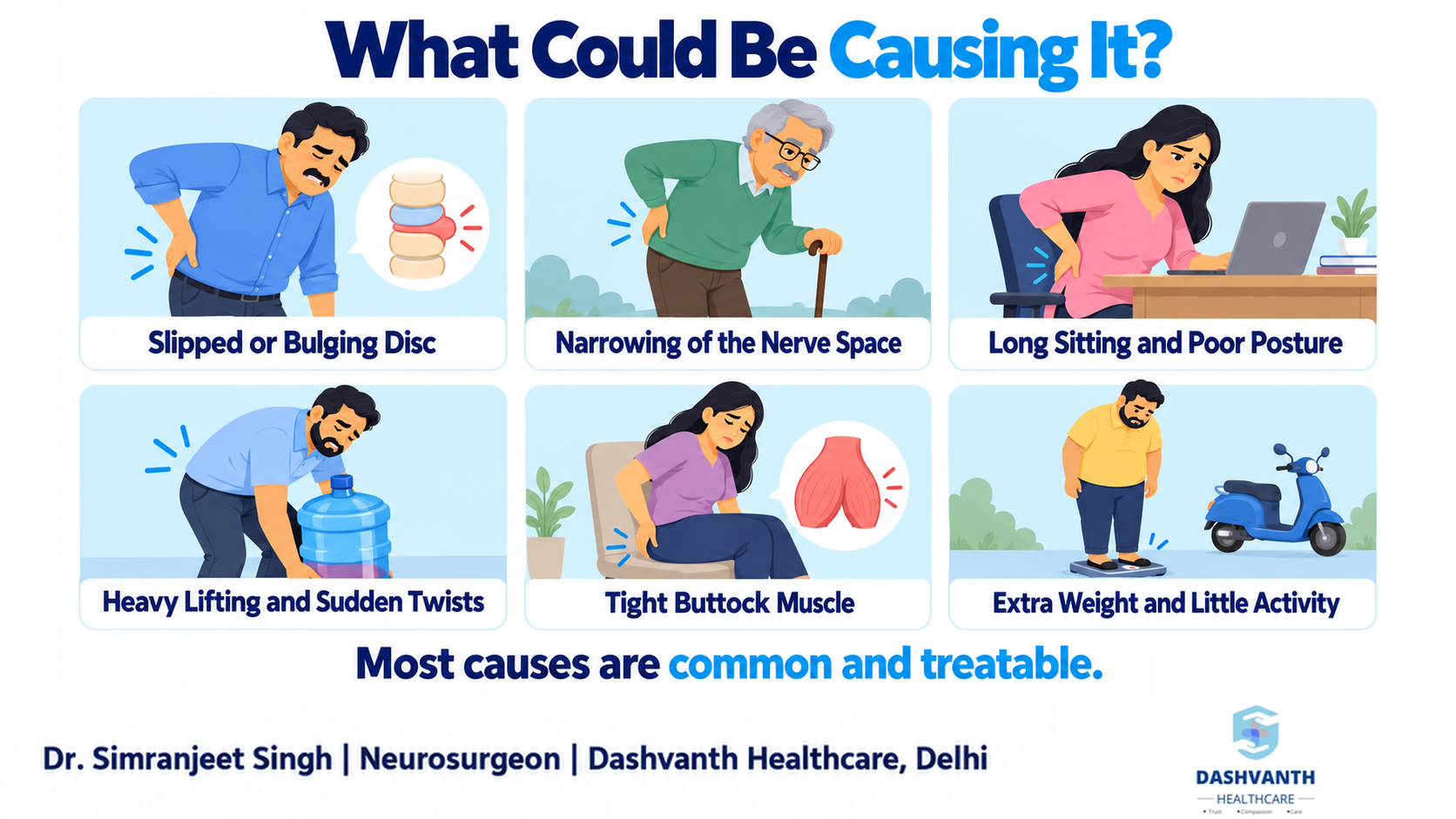
A slipped or bulging disc. Between the bones of your spine are soft cushions called discs. Sometimes the inner part of a disc pushes outward and presses on a nearby nerve. This is the most common cause, and it becomes more likely as we get older. NHS: Sciatica causes.
Narrowing of the space around the nerves. With age, the small tunnels that the nerves pass through can become tighter. This is called spinal stenosis. It is more common in older adults, and the leg pain often comes on with walking.
Wear and tear. Years of heavy lifting, long hours of sitting, or simply the natural ageing of the spine can cause small bony changes that crowd the nerve.
Muscle tightness in the buttock. Sometimes a deep buttock muscle called the piriformis becomes tight and irritates the nerve. It can feel very similar to a disc problem.
Other contributors. Extra body weight, a sedentary routine, pregnancy, a past back injury, and long hours of driving or desk work can all raise the chances of sciatica. Less often, a slipped vertebra or an injury is behind it.
How it disrupts real life
Sciatica rarely stays politely in one place. It follows you through the day.
Sitting. This is often the hardest part. Long meetings, office chairs, bus rides, and car seats can bring on or worsen the pain. Many people find they keep shifting weight to one side, or stand up every ten minutes.
Sleeping. You may wake at night because the leg aches or tingles. Lying flat on your back or on the painful side may be uncomfortable, and getting out of bed in the morning can feel stiff and sharp.
Walking and standing. Some people can walk only a short distance before the leg pain or heaviness forces them to stop. Others find standing in one spot, such as at a kitchen counter, hard to tolerate.
Working. If your job involves lifting, driving, or long hours at a computer, sciatica can quietly drain your concentration and energy. Pain makes people irritable and tired, and that affects work and family life too.
Driving and daily chores. Pressing the clutch, getting in and out of a car, bending to pick up a child, or putting on socks can all become small daily struggles.
Your mood. Constant pain is exhausting. It is completely normal to feel low or worried when it goes on for weeks. Please don’t ignore that part.
What you can do at home
The majority of sciatica improves within a few weeks to a few months. NHS: How you can ease sciatica pain yourself. These simple steps help many people:
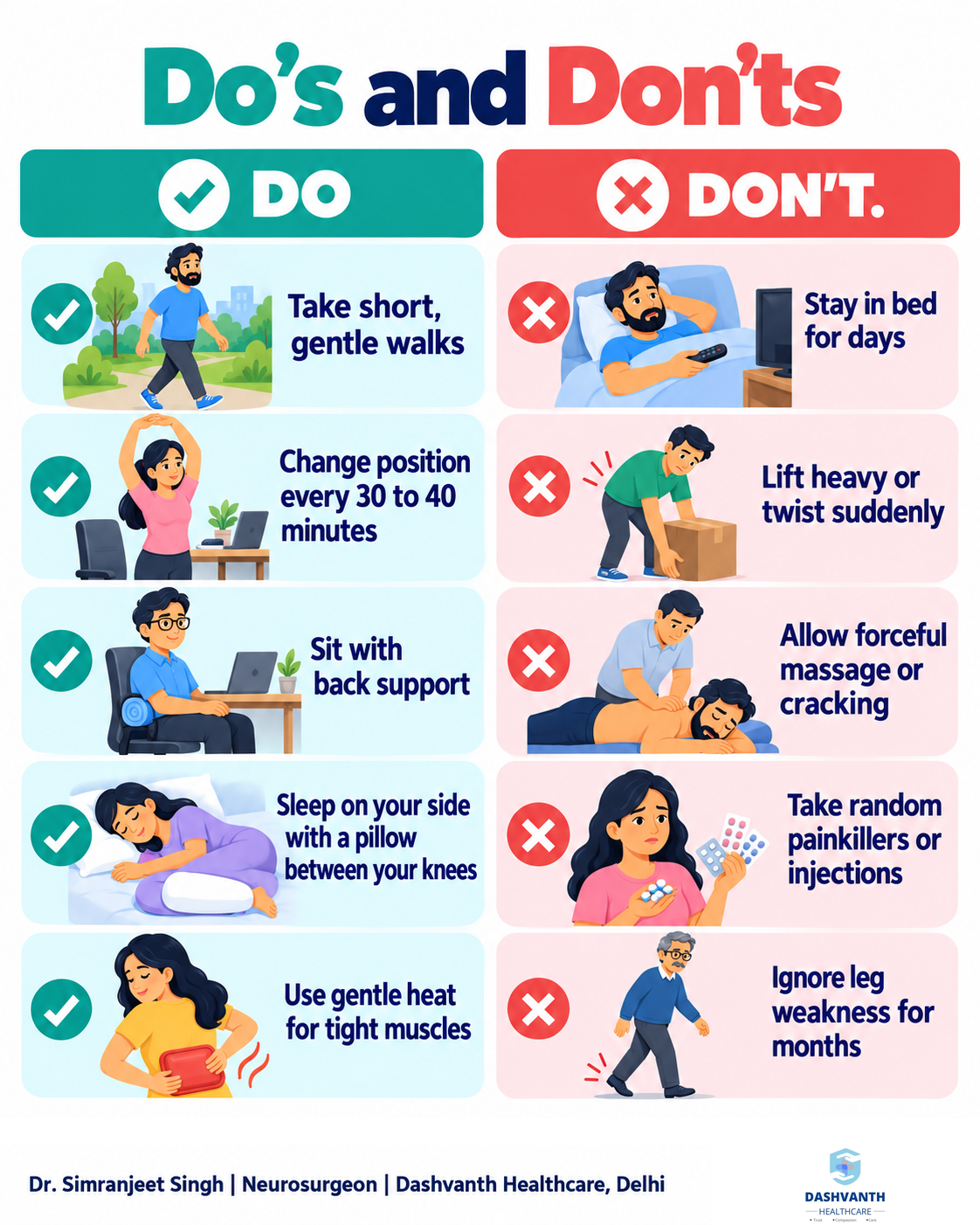
- Stay gently active. Short, slow walks several times a day are usually better than lying in bed. Complete bed rest tends to make the back stiffer and recovery slower. NICE guidance likewise advises encouraging people with sciatica to continue normal activities. NICE NG59: Low back pain and sciatica in over 16s.
- Change position often. Don’t sit for more than 30 to 40 minutes at a stretch. Stand, walk for a couple of minutes, and sit again.
- Try heat. A warm compress on the lower back can relax tight muscles. Use it for about 15 to 20 minutes at a time, and check that it is not too hot against your skin.
- Sit with support. Place a small rolled towel or cushion behind your lower back. Keep your feet flat on the floor.
- Sleep smart. Try lying on your side with a pillow between your knees, or on your back with a pillow under your knees.
- Gentle stretching. Light stretches for the hamstrings and buttock, learned from a physiotherapist, can help. They should ease the pain, not provoke it.
- Pain relief with care. Simple pain relievers can help in the short term, but please check with your doctor before using them regularly, especially if you have stomach, kidney, or heart issues. NICE advises against gabapentin-type medicines, oral steroids and benzodiazepines for sciatica, and says anti-inflammatory painkillers should be used at the lowest effective dose for the shortest time. NICE NG59: Low back pain and sciatica in over 16s.
What not to do
- Don’t stay in bed for days. It feels safe, but it usually slows recovery.
- Don’t lift heavy weights or twist suddenly while the pain is active. This includes heavy bags, water cans, and gym deadlifts.
- Don’t push through sharp pain in the gym or in yoga. A stretch should feel like a gentle pull, not an electric shock.
- Don’t rely on random pain-killer injections or strong medicines from a chemist without a proper diagnosis.
- Don’t let strong massages or “cracking” manipulations be done by someone untrained. Forceful treatment on an irritated nerve can sometimes make things worse.
- Don’t ignore it for months hoping it will disappear on its own, especially if it keeps getting worse.
When it’s a good time to seek medical advice
Most people don’t need surgery, and a visit to a specialist is not a reason to panic. It simply helps you get a clear answer. Consider arranging a medical assessment if:
- the pain has lasted more than 4 to 6 weeks despite rest, gentle activity, and simple measures
- the pain is getting stronger, or waking you repeatedly at night
- the leg feels weak, the foot drags, or you trip more often
- numbness or tingling is spreading or not improving
- the pain keeps coming back
- you can’t do your normal work or daily activities
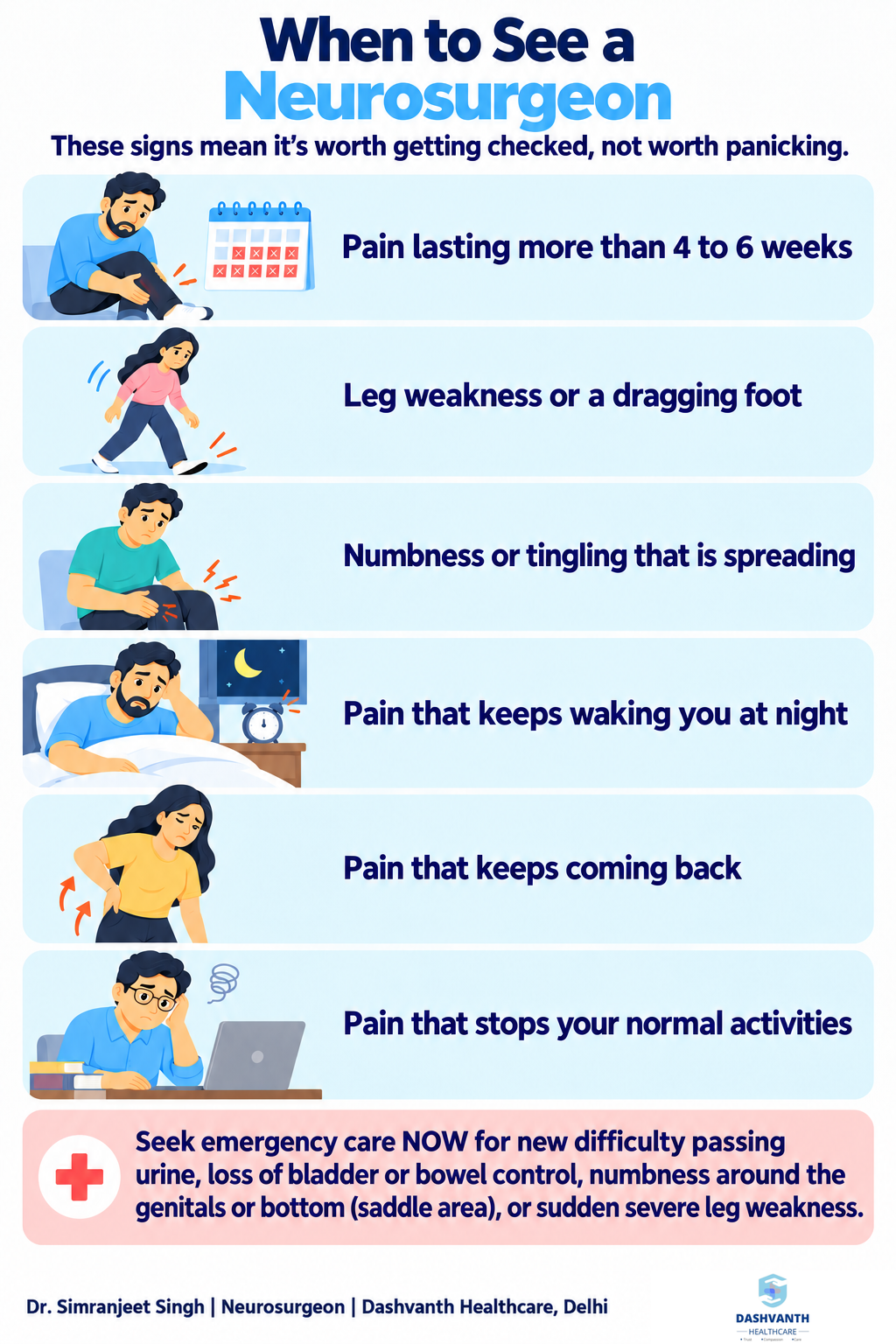
Some signs need attention the same day. Please go to a hospital emergency department without waiting, rather than booking a routine appointment, if you notice:
- new difficulty passing urine or controlling your bladder or bowels
- numbness in the groin, inner thighs or around the bottom
- sudden, significant weakness in one or both legs, or weakness or numbness that is getting worse
- sciatica affecting both legs
- back pain after a serious fall or accident, or together with fever and unexplained weight loss
These are uncommon, but acting quickly protects the nerves. The first four signs follow NHS advice on when to go to A&E for sciatica. NHS: Sciatica, immediate action required. If you can, ask someone to take you rather than driving yourself.
What a specialist will do
At a specialist consultation, the doctor will listen carefully to your story and examine your back, your reflexes, and the strength and sensation in your legs. Often that is enough to understand the problem. If needed, an MRI scan can help identify a disc problem or pressure on a nerve; the findings are interpreted alongside your symptoms and examination. NICE advises against routine imaging and suggests it is considered only when the result is likely to change treatment. Many patients are then treated with medicines, targeted physiotherapy, and lifestyle changes. Procedures such as an injection are considered in some cases, and surgery is reserved for the smaller group who have persistent severe pain or nerve weakness that doesn’t improve. NICE says an epidural injection of local anaesthetic and steroid can be considered for acute, severe sciatica, and that spinal decompression can be considered when non-surgical treatment has not improved pain or function and scan findings match the symptoms. NICE NG59: Low back pain and sciatica in over 16s.
The usual aim is to use the least invasive approach that works for the individual. If an MRI has shown a lumbar disc herniation and surgery is being discussed, this guide to when surgery is considered and what the alternatives are explains the options in more detail.
A word of reassurance
Sciatica can be frightening when the pain is sharp and the leg feels unreliable. But most people recover, and understanding what’s going on already makes it feel less scary. Move gently, protect your back, and don’t wait too long to ask for help if it isn’t settling.
If your symptoms are not settling, or you are unsure what they mean, a medical assessment can give you a clearer answer. You may bring a note of when the pain started, what makes it better or worse, and any earlier scans to your appointment.
Dr. Simranjeet Singh
M.Ch. Neurosurgery (AIIMS, New Delhi)
Director, Dashvanth Healthcare, Delhi.
Consultant Neurosurgeon, Max Smart Super Speciality Hospital, Saket.
Learn more about Dr. Simranjeet Singh.
The illustrations in this article are digitally created for representation and education.
This article is for general education and does not replace a personal medical consultation.