Sometimes the leg pain has been there for weeks. An MRI has been done, and the report uses words such as “disc prolapse”, “extrusion” or “L5-S1 herniation compressing the nerve root”. Someone in the family has heard that “once the disc is out, it needs an operation”. Someone else has heard that “back surgery should be avoided at all costs”. Both cannot be right, and it is natural to feel stuck in the middle.
This article is about that decision point. If you are still trying to understand leg pain that starts in the back, what it feels like and what helps at home, our article on sciatica and what eases it is the better starting point. If your main problem is back pain without leg symptoms, see back pain and what helps. Here, the question is narrower: once a disc herniation has been found, when is surgery considered, and what are the other options?
What a disc herniation is, and what the MRI report means
The discs between the bones of the lower spine have a tough outer ring and a softer inner core. When part of the disc pushes out beyond its normal border, it can press on or inflame a nearby nerve root. That is what produces sciatica-type leg pain, numbness or tingling, and sometimes weakness.
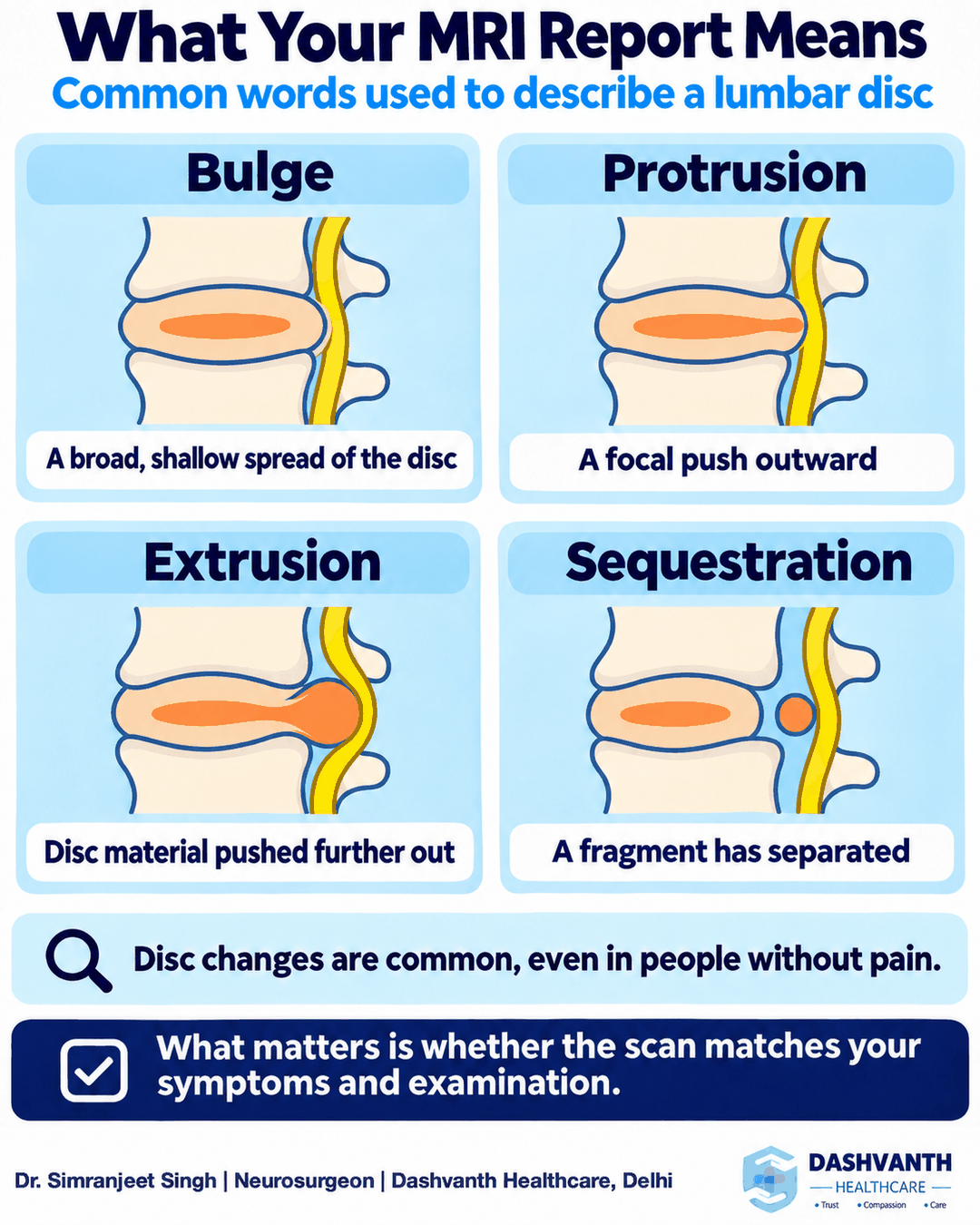
MRI reports often describe the disc using different words. A “bulge” is a broad, shallow spread of the disc. A “protrusion” and an “extrusion” describe a more focal push, and a “sequestration” means a piece has separated from the disc. These terms help doctors, but they do not by themselves decide treatment.
There are two important points to understand about scans. First, disc changes are very common in people who have no pain at all. A large review of scans in people without symptoms found that disc bulges and other disc changes were common at every adult age and became more common with each decade, and concluded that scan findings “must be interpreted in the context of the patient’s clinical condition”. AJNR 2015 systematic review. So a disc on the scan is only meaningful if it matches your symptoms and examination.
Second, herniated discs can shrink on their own. A systematic review of repeat scans in people treated without surgery found that many herniated discs became smaller over time, and some disappeared completely. Clinical Rehabilitation 2015 systematic review. Interestingly, the larger, more dramatic-looking fragments were the ones most likely to regress. A frightening-sounding MRI report does not automatically mean an operation.
First, the signs that need emergency care
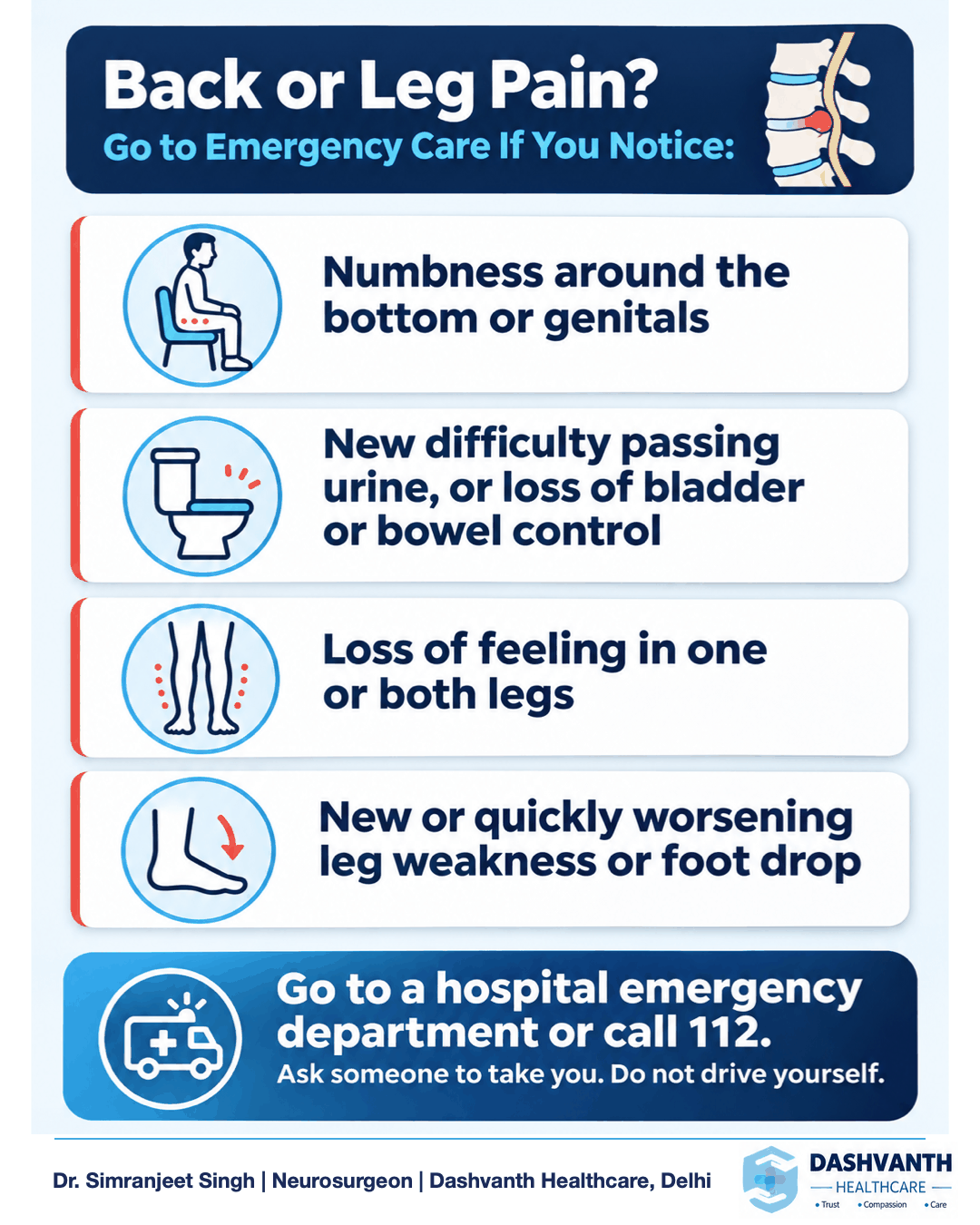
A small number of people with a disc herniation develop pressure on the bundle of nerves that controls the bladder, bowel and sensation around the bottom. This is called cauda equina syndrome, and it is an emergency. The NHS advises calling for emergency help or going to A&E if back pain comes with numbness around the bottom or genitals, being unable to pass urine, loss of feeling in one or both legs, or being unable to control when you pass urine or stool. NHS: Slipped disc. Rapidly worsening weakness in a leg, or a foot that suddenly starts to drag, also needs urgent assessment the same day.
In India, this means going directly to a hospital emergency department or calling 112 or an ambulance, not waiting for a routine appointment. Ask someone to take you rather than driving yourself.
How doctors decide what to recommend
Outside of emergencies, the decision is rarely about the scan alone. The treating team usually weighs several things together:
- How the leg pain is changing. Many people improve steadily over weeks. Others plateau or get worse.
- The examination. Doctors check reflexes, strength, sensation and nerve-stretch signs, and compare them with the level shown on the MRI.
- Nerve weakness. Weakness that is significant or progressing is treated more seriously than pain alone.
- How long it has lasted, and how much it limits life. Sleep, work, walking and mood all count.
- Your own priorities. Some people prefer to wait and see, others want faster relief, and both can be reasonable choices.
NICE guidance says spinal decompression can be considered for people with sciatica “when non-surgical treatment has not improved pain or function and their radiological findings are consistent with sciatic symptoms”. NICE NG59. In other words, surgery is generally discussed when two conditions meet: conservative care has not been enough, and the scan matches the symptoms.
NICE also states that a person’s weight, smoking status or psychological distress should not by themselves influence the decision to refer them for a surgical opinion. NICE NG59.
The alternatives to surgery
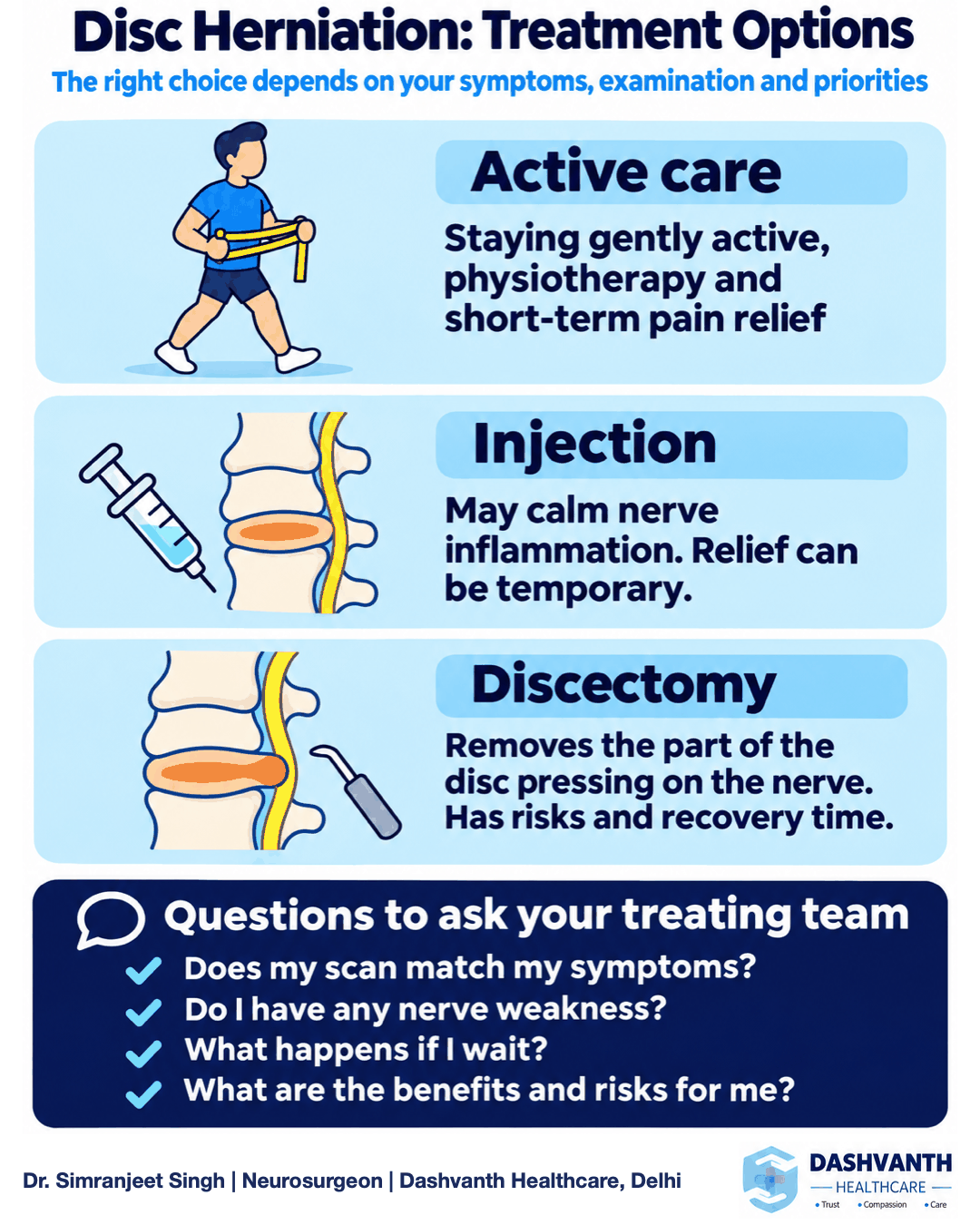
Watchful waiting with active care. For many people this is the main treatment, not a delay. It includes staying gently active, physiotherapy-guided exercise, adjusting work and sitting habits, and short-term pain relief chosen with a doctor. The NHS notes that a slipped disc usually gets better slowly with rest, gentle exercise and painkillers, and that surgery is not usually needed. NHS: Slipped disc.
Medicines, used carefully. Pain relief can make it easier to keep moving. NICE advises against some medicines for sciatica, including gabapentin-type drugs, oral steroids and benzodiazepines, so it is worth asking why a particular medicine has been suggested. NICE NG59.
Epidural steroid injection. NICE says an epidural injection of local anaesthetic and steroid can be considered for acute and severe sciatica. NICE NG59. An injection does not remove the disc. It aims to calm nerve inflammation and reduce pain while the body recovers. A UK randomised trial (NERVES) compared a targeted (transforaminal) epidural steroid injection with microdiscectomy in people whose sciatica had lasted between six weeks and twelve months. At 18 weeks, the difference in disability scores between the two groups was not statistically significant, serious adverse events were reported only in the surgery group, and the authors suggested that the injection be considered as a first invasive option. Lancet Rheumatology 2021, NERVES trial. Injections are not suitable for everyone and the relief may be temporary, so this is a discussion for the treating team.
When surgery is discussed
The usual operation for a lumbar disc herniation is a discectomy, often done as a microdiscectomy. The surgeon removes the portion of disc that is pressing on the nerve, leaving the rest of the disc in place. The aim is mainly to relieve leg pain and protect nerve function. It is not designed to cure long-standing back pain.
Surgery tends to be discussed in situations such as:
- emergency nerve compression, such as cauda equina syndrome
- significant or progressive weakness
- severe leg pain that has not improved with a reasonable period of non-surgical care, with a scan that matches the symptoms
- repeated episodes that keep disrupting life
What does research say about timing? In a Dutch trial, people with severe sciatica lasting several weeks were assigned either to early surgery or to continued conservative care, with surgery later if needed. Early surgery gave faster relief of leg pain and faster recovery. At one year, however, outcomes were similar in both groups, and most people in both groups reported recovery. A substantial minority of the conservative group eventually had surgery. NEJM 2007, Peul et al..
This is one of the most useful facts for patients. For many people without emergency signs, the choice is less about whether they will eventually recover and more about how quickly, and what they are willing to accept along the way.
NICE recommends against offering spinal fusion for low back pain outside a research trial, and against disc replacement for low back pain. NICE NG59. If a larger operation is suggested for a straightforward disc herniation, it is reasonable to ask why.
Risks and limitations of surgery
Every operation carries risk, and the discussion should be specific to you. General risks include infection, bleeding and the effects of anaesthesia. Spine-specific risks include a tear in the lining around the nerves, nerve injury, and the disc herniating again at the same level, sometimes needing a further procedure. Surgery may not fully relieve symptoms, and it may not help back pain. The Academy of Medical Royal Colleges’ patient guidance notes that “many people’s symptoms will improve without surgery” and that discectomy may help when scans show a slipped disc and other treatments have not improved symptoms over time. Academy of Medical Royal Colleges: Discectomy for a slipped disc.
Not having surgery also has trade-offs: a longer period of pain for some people, and, in the case of significant nerve weakness, a risk that recovery of strength is less complete. That is why weakness changes the conversation.
Recovery and follow-up
After a discectomy, most people are encouraged to walk early. Return to desk work, driving and heavier activity depends on the individual and the surgeon’s advice. Numbness can take longer to settle than pain. Physiotherapy and a gradual return to activity are usually part of recovery, whether or not surgery was done.
Whatever path you choose, follow-up matters. New weakness, bladder or bowel changes, fever, or wound problems after surgery need prompt medical attention.
Questions you may find useful to ask
- Does my scan finding match my symptoms and examination?
- Do I have any nerve weakness, and is it changing?
- What are my options at this stage, including continuing non-surgical care?
- If I wait, what signs would change your advice?
- What are the realistic benefits and the specific risks of surgery for me?
- What will recovery look like for my work and family responsibilities?
A word of reassurance
Finding a disc herniation on an MRI can feel like a turning point, but for many people it is one step in a recovery that often happens with time and active care. Surgery is a helpful option for some, particularly when nerves are under serious pressure or pain does not settle, and it is one choice among several rather than an automatic next step. Management depends on your symptoms, your examination and your priorities. You may bring your MRI images and report, along with a note of how your leg pain has changed, to your appointment, which can make the discussion clearer.
Dr. Simranjeet Singh
M.Ch. Neurosurgery (AIIMS, New Delhi)
Director, Dashvanth Healthcare, Delhi.
Consultant Neurosurgeon, Max Smart Super Speciality Hospital, Saket.
Learn more about Dr. Simranjeet Singh.
The illustrations in this article are digitally created for representation and education.
This article is for general education and does not replace a personal medical consultation.