Some situations cannot wait for an appointment. A sudden, severe headache (often described as “the worst headache of my life”), sudden face drooping, sudden weakness on one side, or sudden trouble speaking or seeing are signs of a possible stroke or bleed. Go to the nearest emergency department right away. Every minute counts. You can read more about this in my article on stroke warning signs. MedlinePlus: Headache danger signs.
It starts small. A headache that seems to come back a little more often than it used to. Words on your phone screen that look slightly fuzzy by evening. A hand that feels clumsy when you button your shirt, or a leg that drags a little on the stairs. Each thing on its own is easy to explain away: too much screen time, a bad night’s sleep, getting older.
But when these things don’t go away, or when they start turning up together, it’s natural to worry. Many people tell me they spent weeks searching online, going back and forth between “it’s nothing” and “it’s something terrible.” Most of the time, the truth is much closer to the first. Still, there are a few patterns worth knowing, so you can tell the difference between what can wait and what deserves a proper check.
What it actually feels like
People describe these symptoms in many different ways.
Headaches may be a dull pressure across the forehead, a band around the head, a throbbing on one side, or an ache behind the eyes. Some come and go. Others build up slowly over days or weeks.
Vision changes can mean blurring that doesn’t clear when you blink, seeing double, flickering lights or zigzag lines, a grey patch in part of your vision, or simply feeling that your eyes are working harder than before.
Weakness or numbness may show up as dropping things more often, a weak grip, tingling in an arm or leg, one side of the face feeling different, or feeling unsteady when you walk.
Sometimes these symptoms come alone. Sometimes they come together, and that combination is one of the things I pay closest attention to.
What could be causing it: the common reasons
The good news first: most causes of persistent headaches and vision complaints are common and treatable.
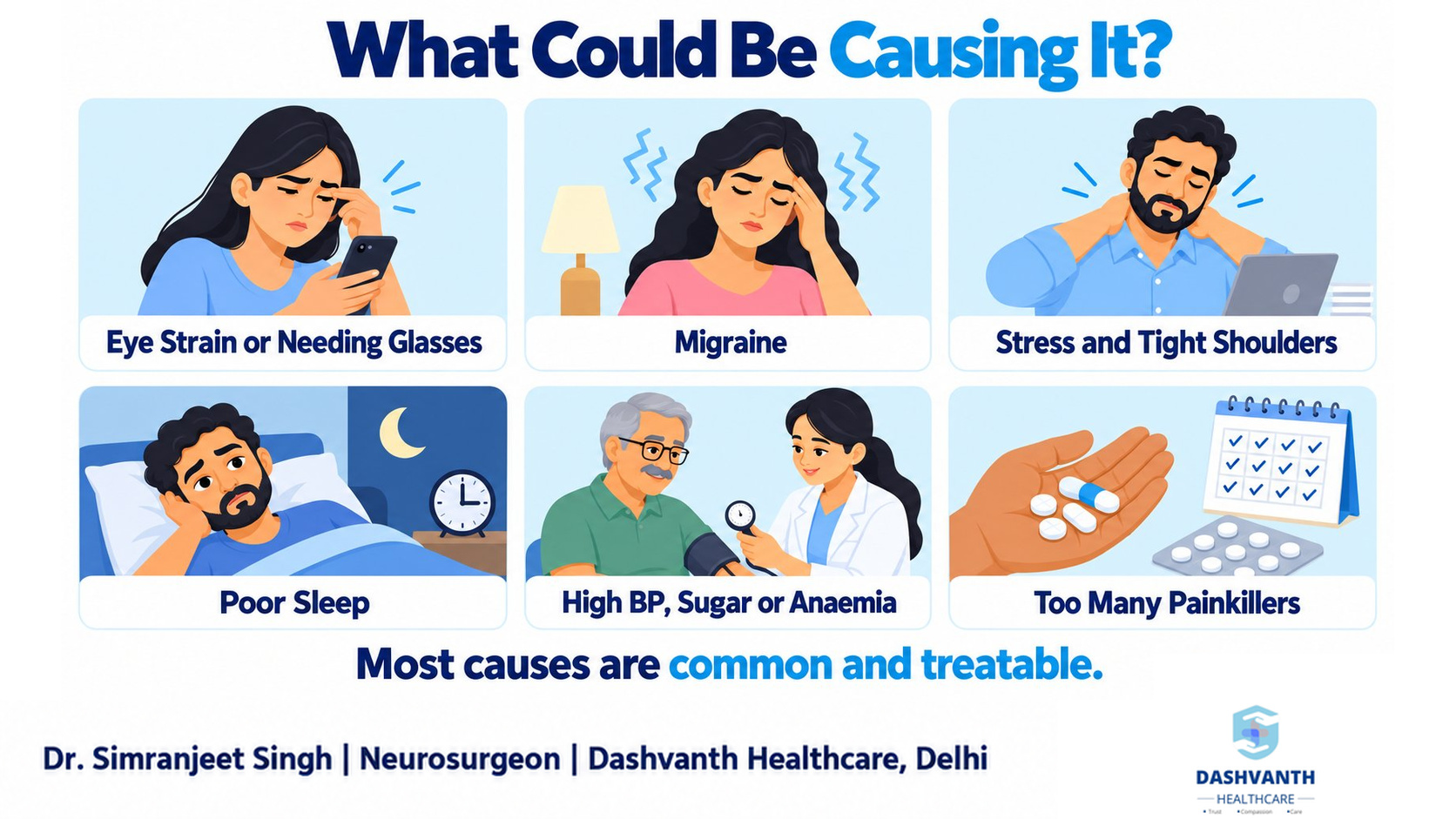
Eye strain or needing glasses. Long hours on screens, or a change in your eyesight that hasn’t been corrected yet, can cause frontal headaches and blurred vision by evening. A simple eye test often solves this.
Migraine. Migraine can bring a throbbing headache along with sensitivity to light, nausea, and sometimes visual changes such as flashing lights or zigzag lines before the pain starts. Some people even feel temporary tingling or heaviness on one side. Migraine is very common and very treatable, but it needs a proper diagnosis.
Stress and tight shoulders. Tension in the neck and shoulders, especially after long desk hours, is one of the most common causes of daily headaches.
Poor sleep. Too little sleep, irregular hours, or snoring with breathing pauses at night can all lead to morning headaches and tiredness.
High blood pressure, high sugar or anaemia. High blood pressure usually causes no symptoms; headache or blurred vision can occur less commonly. A blood pressure measurement is needed to identify it. NHS: High blood pressure. Diabetes can change vision and cause tingling in the hands and feet. Anaemia can bring headaches, tiredness and weakness.
Too many painkillers. This surprises many people. Taking painkillers for headaches on most days can actually keep the headaches going. This is called medication-overuse headache, and it improves once the pattern is changed with a doctor’s help.
Less commonly, symptoms that keep worsening point to something inside the brain or spine that needs attention, such as raised pressure inside the head, a growth, a blood clot after a minor fall, or pressure on the spinal cord in the neck. These are much rarer, and many of them are very treatable when they’re found early. That is exactly why the warning signs later in this article matter.
How it affects everyday life
Symptoms like these quietly take over your day.
At work, a constant headache makes it hard to concentrate. Reading reports or spreadsheets becomes tiring when your vision blurs, and you may find yourself re-reading the same line again and again.
On screens, your eyes feel heavy within an hour. Many people start avoiding their phone or laptop without realising why.
While driving, blurred or double vision is not just uncomfortable, it is unsafe. Weakness in a leg or hand can make braking or steering harder than it should be.
At home, small tasks become frustrating: threading a needle, writing a note, carrying a cup of tea without spilling it, climbing stairs.
At night, a headache may make it hard to fall asleep, or you may wake up with one. Poor sleep then makes the next day’s headache worse, and the cycle continues.
Many people also carry a quiet worry in the background, which itself can make headaches and tension worse.
What helps, and what to avoid
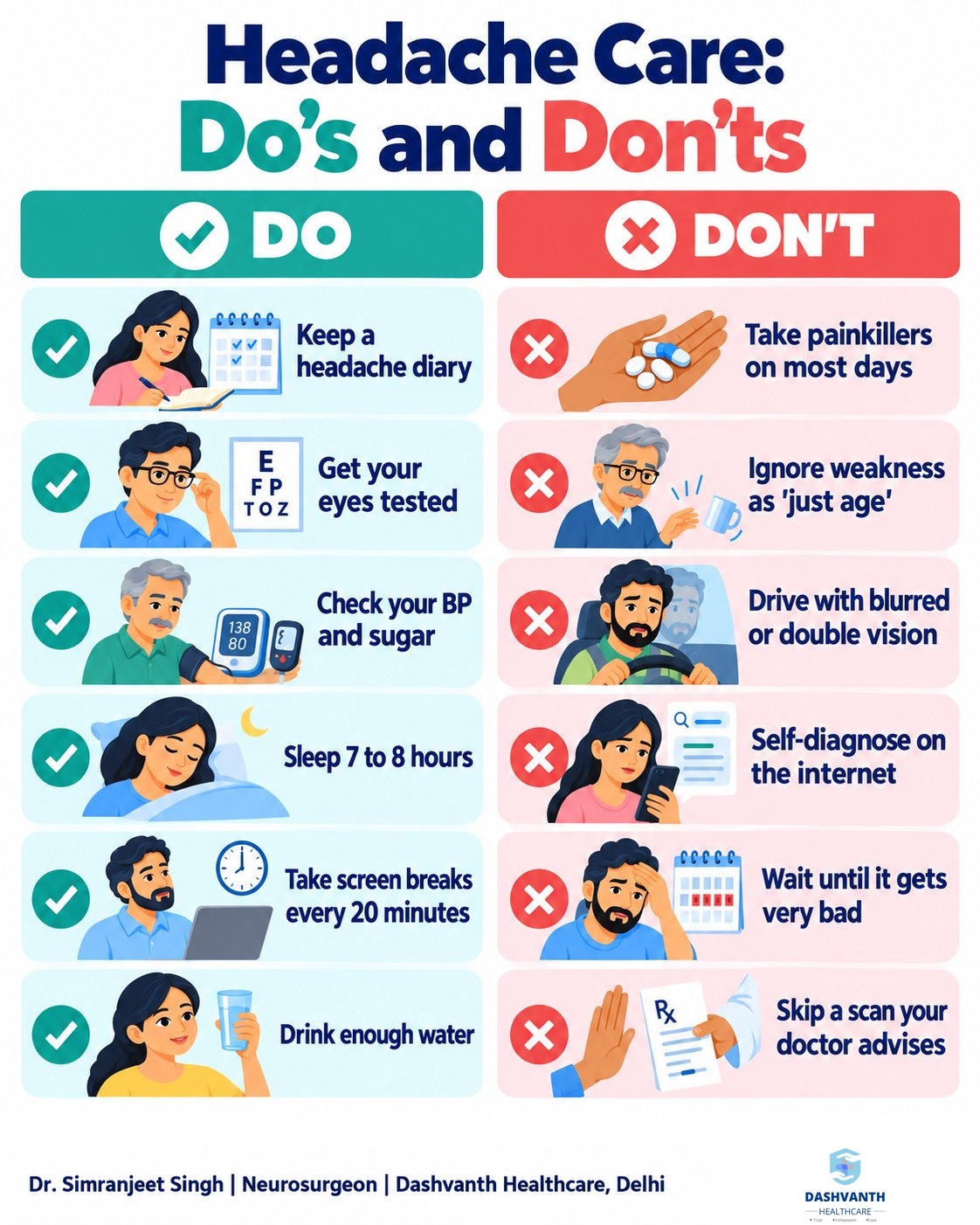
What to do:
- Keep a headache diary. Record headache frequency, duration and severity, associated symptoms, possible triggers and all medicines taken. NICE recommends at least eight weeks of records when using a diary to help diagnose a primary headache disorder. Do not delay medical assessment to complete the diary. NICE: Headache assessment.
- Get your eyes tested. Especially if your headaches are worse after reading or screen work.
- Check your blood pressure and sugar. These are simple, inexpensive checks that can explain a great deal.
- Sleep seven to eight hours, at regular times.
- Take screen breaks every 20 minutes. Look at something far away for 20 seconds to rest your eyes.
- Drink enough water through the day, and don’t skip meals.
What not to do:
- Don’t take painkillers on most days. If you need them more than two or three days a week, it’s time to see a doctor.
- Don’t ignore weakness as “just age.” New weakness in a hand, arm, leg or the face always deserves a check.
- Don’t drive with blurred or double vision. Get it assessed first.
- Don’t self-diagnose on the internet. It tends to either frighten you unnecessarily or falsely reassure you.
- Do not wait for symptoms to become severe. Seek assessment for a new or changing headache, and emergency care for the warning signs described above.
- Discuss whether a scan is needed. Imaging should follow clinical assessment. NICE advises against brain imaging solely for reassurance in people diagnosed with migraine, tension-type, cluster or medication-overuse headache. NICE: Headache management.
When it’s time to see a neurosurgeon
Most headaches are not serious. But some signs mean it’s worth getting checked properly. These are not reasons to panic. They are reasons to see someone who can examine you and, if needed, arrange the right scan.
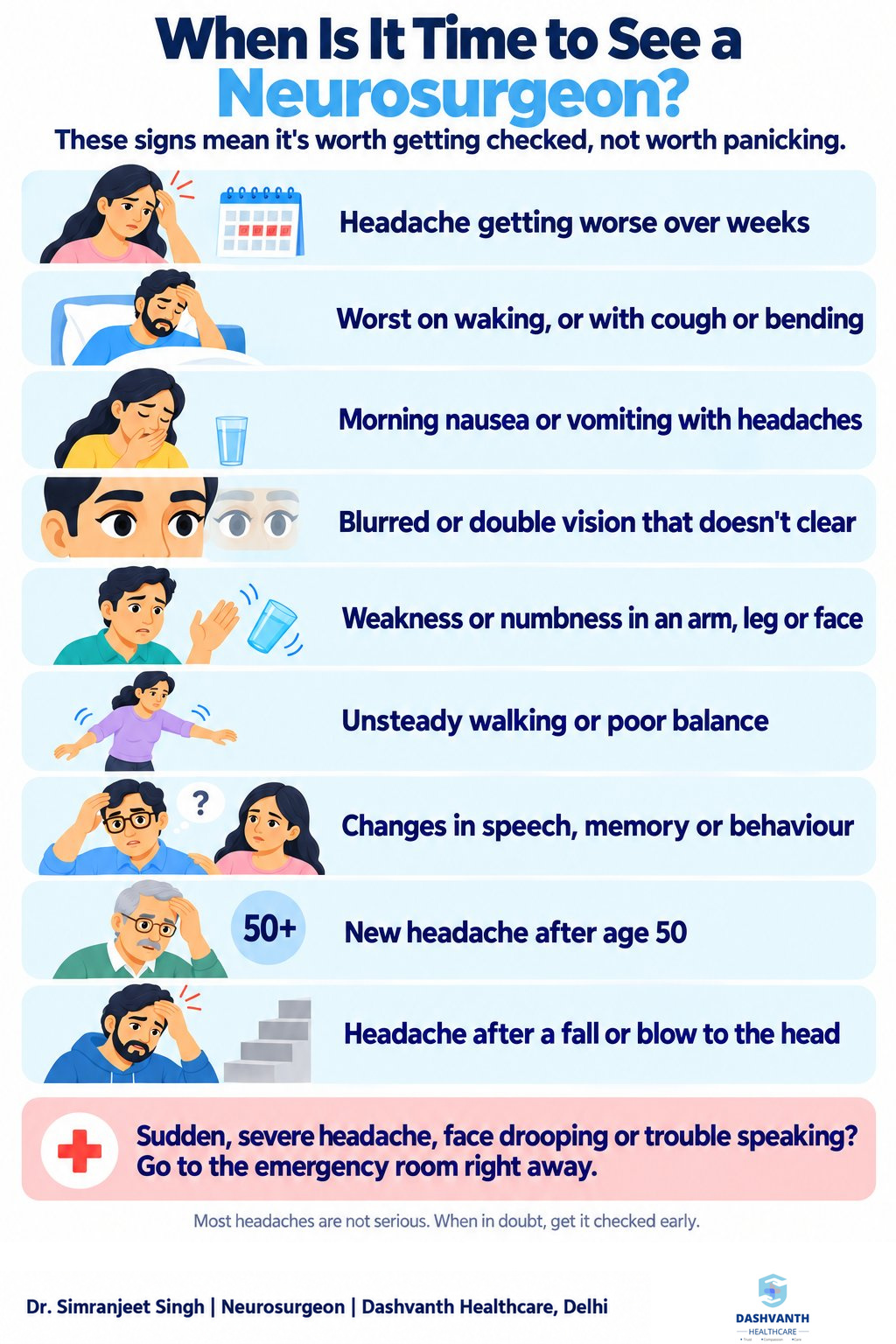
Seek medical assessment for the following symptoms. Sudden neurological symptoms or a sudden severe headache require emergency care rather than a routine appointment:
- A headache that is getting steadily worse over weeks
- A headache that is worst on waking, or worse when you cough, strain or bend
- Morning nausea or vomiting along with your headaches
- Blurred or double vision that doesn’t clear
- Weakness or numbness in an arm, leg or one side of the face
- Unsteady walking or poor balance
- Changes in speech, memory or behaviour that family members have noticed
- A new kind of headache that starts after the age of 50
- A headache after a fall or a blow to the head, even a minor one, especially if you take blood thinners
If your main concern is a headache on its own that keeps coming back, my earlier article on headaches that won’t go away covers that in more detail.
A word about getting help
Dr. Simranjeet Singh consults at Dashvanth Healthcare in Krishna Nagar, Delhi, and Max Smart Super Speciality Hospital in Saket, New Delhi. Assessment considers the symptom history and clinical examination; any investigations and treatment depend on the findings.
We’ll listen to your story, examine you carefully, explain what we find in plain language, and only advise a scan or treatment when it’s genuinely needed.
Know the signs. Get clarity, not worry.
Dr. Simranjeet Singh
M.Ch. Neurosurgery (AIIMS, New Delhi)
Director, Dashvanth Healthcare, Delhi.
Consultant Neurosurgeon, Max Smart Super Speciality Hospital, Saket.
This article is for general education and does not replace a personal medical consultation.