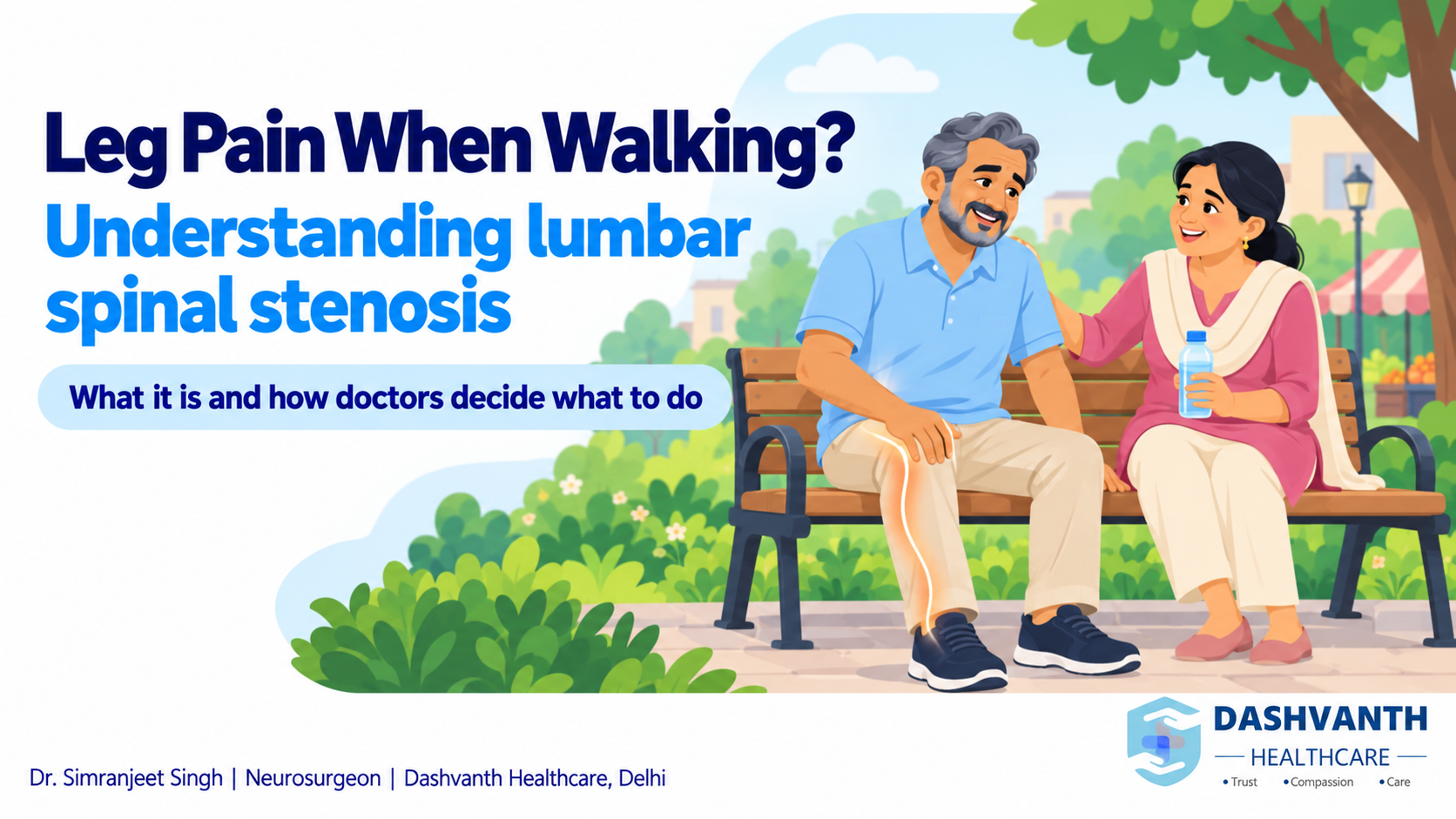
Some people describe it as a heaviness. Others feel burning, tingling or weakness creeping into one leg or both, after walking to the end of the lane, across a supermarket, or after a few minutes standing at the kitchen counter. Then they sit down, or lean forward on a trolley, and the legs settle. A few minutes later they can walk again, until it returns.
This pattern has more than one possible explanation, and lumbar spinal stenosis is one of them. This article explains what the term means, how doctors tell it apart from other causes of leg pain, what the treatment choices are (including care without an operation), and what research can and cannot tell us. If your leg pain is mostly sharp, shooting and linked to a disc, the article on sciatica may fit better. For back pain without leg symptoms, see back pain: when to seek medical assessment.
What is lumbar spinal stenosis?
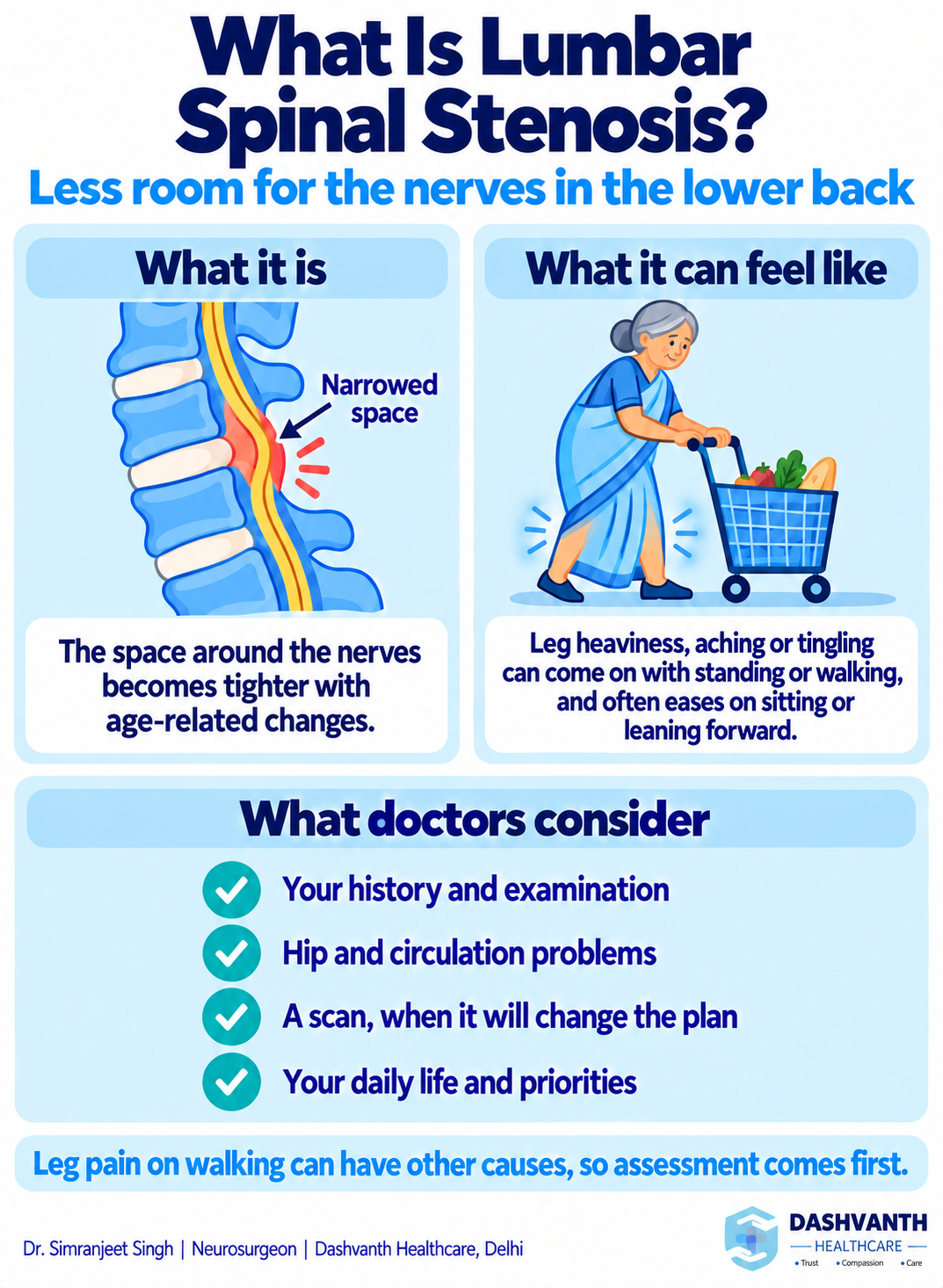
“Stenosis” means narrowing. Your spine has a central channel, the spinal canal, and small side tunnels where nerves leave it. In the lower back these carry the nerves that go to your legs. When the space around them becomes tighter, the nerves can be squeezed, and their blood supply can be affected too.
The most common reason is age-related change over many years. Discs lose height and bulge, the small joints at the back of the spine thicken, and ligaments can become thicker. These changes are very common, and not everyone who has them has symptoms. That is one reason doctors look at the whole picture and not only at a scan.
What does it feel like, and what else could it be?
The classic pattern is leg discomfort that comes on with walking or standing and eases with sitting or bending forward. Doctors sometimes call this neurogenic claudication. The discomfort can be an ache, heaviness, cramping, tingling or numbness, and may involve the buttocks, thighs or calves, one side or both. Many people find that leaning forward (on a trolley, for example) or sitting brings relief, and that they can often cycle more comfortably than they can walk.
Other conditions can look similar, which is why a pattern alone is not enough to decide:
- Narrowed leg arteries can cause calf pain on walking, but it typically eases within minutes of simply standing still, with no need to sit or bend forward. Weak foot pulses, cold feet or skin changes may point this way.
- A disc problem pressing on one nerve root usually causes pain on one side that may be worse with sitting, coughing or bending.
- Hip arthritis often causes groin or thigh pain that is worse on weight-bearing and on hip movement.
- Nerve damage from diabetes or other causes often causes burning or numb feet that is present at rest too.
More than one of these can be present in the same person, especially in later life. Please treat this list as a way to understand why assessment matters, not as a way to diagnose yourself.
When to seek urgent help
Most people with spinal stenosis develop symptoms gradually. But some features need emergency assessment the same day, and a routine appointment is not the right route. Go to a hospital emergency department if you have:
- new difficulty passing urine, or loss of control of your bladder or bowels
- numbness around the groin, genitals, inner thighs or bottom
- new or rapidly worsening weakness or numbness in one or both legs
- back pain after a serious fall or accident, or with fever and feeling very unwell
These follow NHS advice on when back pain and nerve symptoms need immediate care. NHS: Back pain, NHS: Sciatica. If possible, ask someone to take you rather than driving yourself.
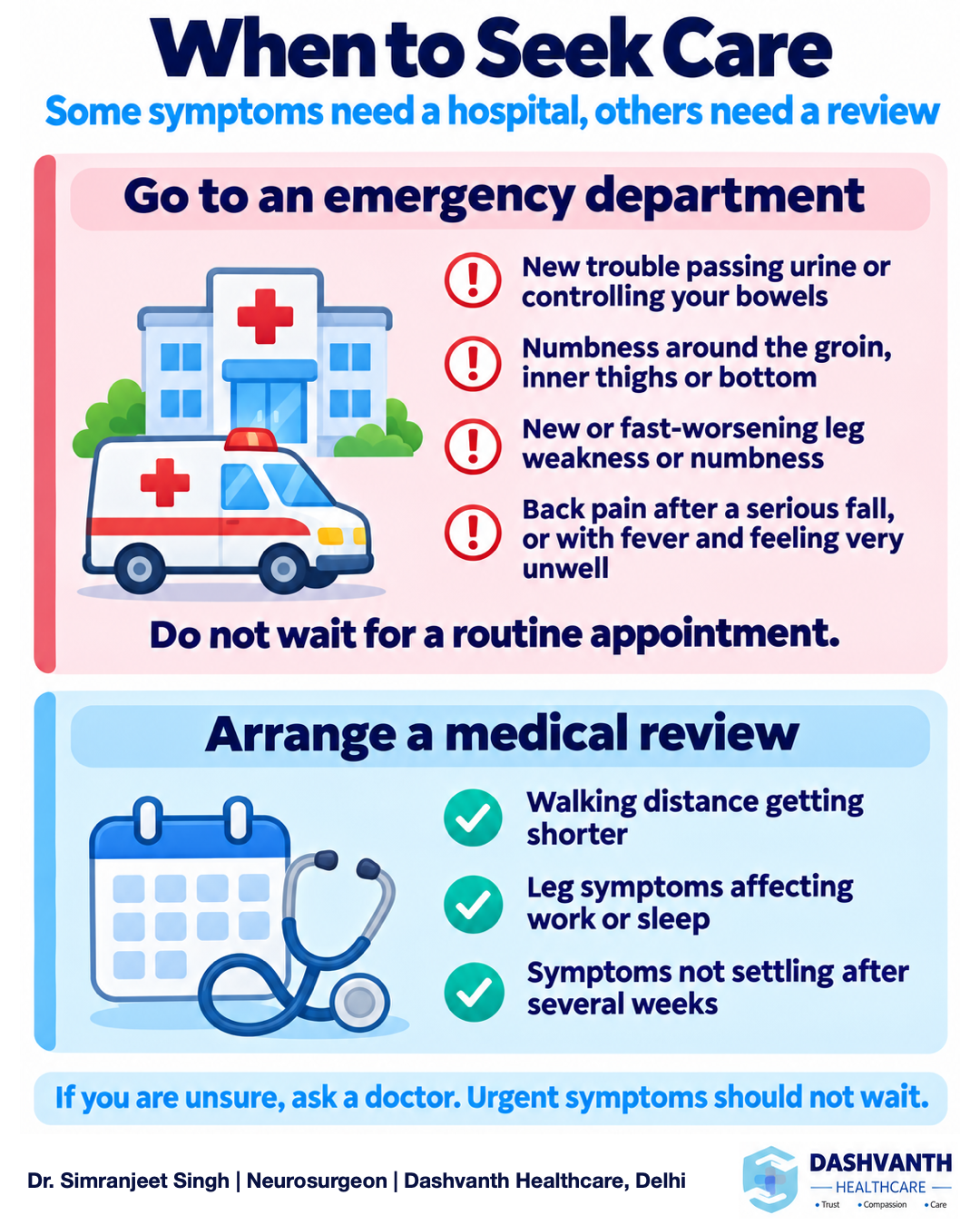
Walking distance that is gradually shrinking, leg symptoms that are affecting work or sleep, or symptoms that are not settling after several weeks are reasons to arrange a medical assessment, with a family doctor or a spine specialist.
How doctors assess it
Assessment starts with your story: when the symptoms come on, what brings relief, how far you can walk, and how it has changed. The examination checks strength, sensation, reflexes, walking, and often the hips and leg pulses. Sometimes the examination between episodes is normal.
An MRI scan is the usual test to show the narrowing. The result is read alongside your symptoms and examination, because narrowing on a scan does not always explain the symptoms. NICE advises against routine imaging for back pain and sciatica and says it should be considered when the result is likely to change management. NICE NG59: Low back pain and sciatica in over 16s. Other tests, such as checking circulation or nerve conduction, are used when the cause is unclear.
Treatment without surgery
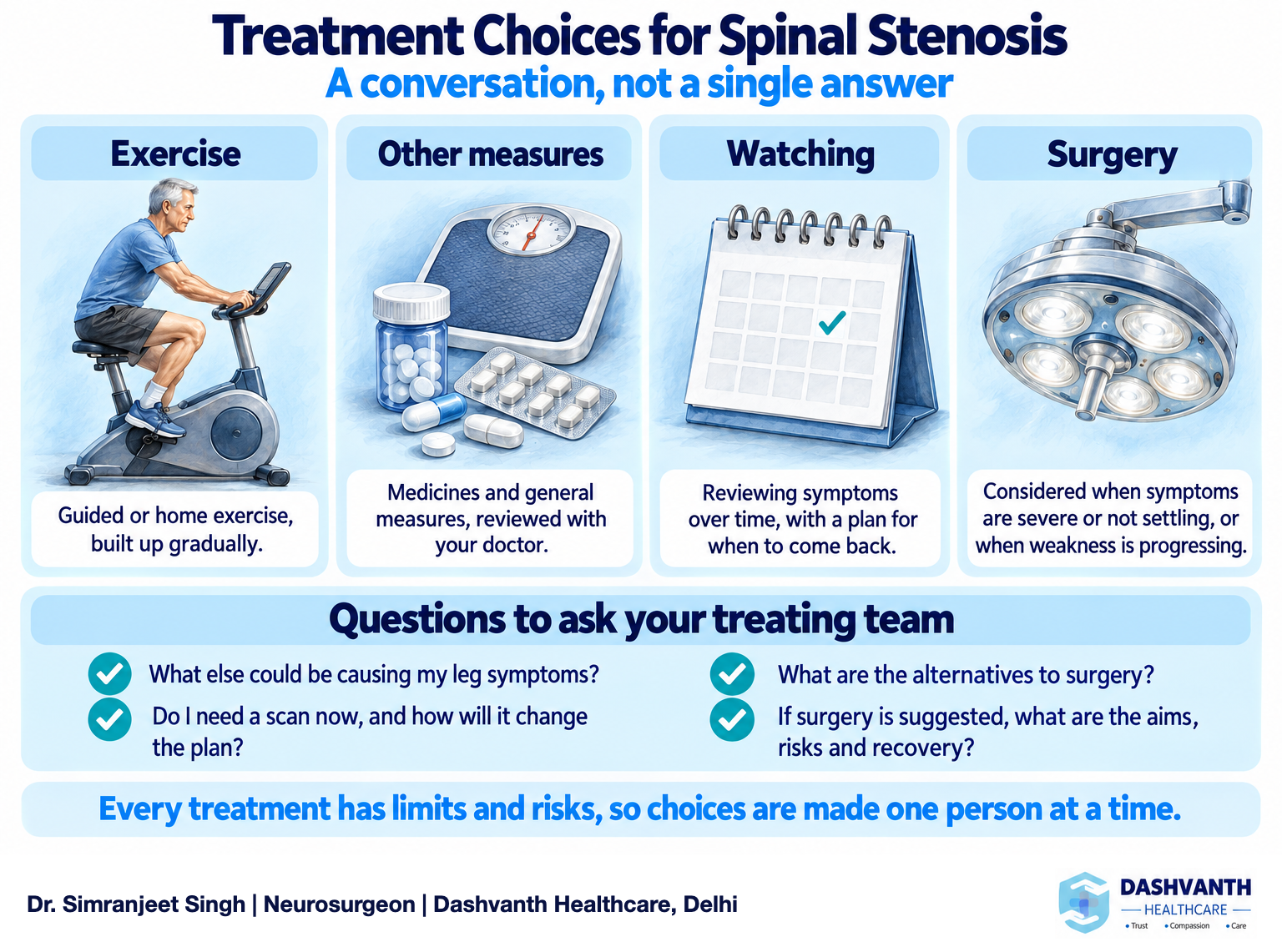
For many people the first approach is not an operation. A treating team may suggest a guided exercise programme with a physiotherapist, advice on pacing walking and daily activity, weight management where relevant, and medicines for pain. Some people also find that a flexed (forward-leaning) posture and stationary cycling let them stay active. For some people the plan is to review symptoms over time, with clear advice on when to come back sooner.
Injections around the spinal nerves are sometimes used for a period of relief in selected people. NICE’s sciatica guidance, which covers only nerve-root pain, advises against some commonly used nerve-pain medicines and oral steroids, so the choice of medicine should be discussed with a doctor and not self-started. NICE NG59.
These measures do not remove the narrowing. They aim to keep you moving and manage symptoms, and some people stay well on this approach for a long time. Others find the limits on walking and daily life too restrictive.
When surgery is discussed
Surgery is usually considered when symptoms are significantly affecting life and non-surgical care has not helped enough, when scan findings match the symptoms, or when there is progressive weakness. NICE’s guidance on sciatica takes a similar position for spinal decompression. NICE NG59. The common operation is a decompression, which creates more room for the nerves by removing part of the structures pressing on them. Some people need a fusion alongside it, for example when a vertebra has slipped or the spine is unstable. The choice depends on the individual’s anatomy, other illnesses, and what matters most to them.
Every operation carries risks, which include infection, bleeding, nerve or spinal-fluid-lining injury, a need for further surgery, and the general risks of anaesthesia, which matter more in older people with other health conditions. Relief of leg symptoms is not guaranteed, and back pain may persist.
What the research does and does not show
Two pieces of evidence are worth knowing about, because they show how mixed the picture is.
The US SPORT trial followed people with spinal stenosis who were candidates for surgery. In the randomised group, many people crossed over: by two years 67% of those assigned to surgery had had it, and 43% of those assigned to non-surgical care also had surgery. Because of that, the randomised comparison showed a benefit of surgery for bodily pain but not for physical function or the Oswestry disability score, whereas the combined as-treated analysis favoured surgery. Weinstein et al., N Engl J Med 2008.
A later Cochrane review of surgery versus non-surgical care concluded that there was very little confidence in whether surgery or conservative treatment is better, and that no clear benefit of surgery was observed. It also noted side effects in 10% to 24% of surgical cases in the included studies, with none reported for conservative treatment. Cochrane review, 2016.
In plain terms, the evidence does not support “everyone needs surgery” or “nobody needs surgery”. The right answer depends on the individual, which is why a clear explanation of benefits, risks and alternatives matters.
Recovery, follow-up and questions to ask
Recovery depends on the treatment and the person. People managed without surgery are usually reviewed to see whether walking distance, pain and daily activities are changing. After an operation, the team should explain wound care, activity limits, rehabilitation and when the next review will be, as timelines differ between people and between procedures.
Questions that can help a conversation with the treating team:
- What is the evidence that the narrowing explains my symptoms?
- Could another condition, such as circulation or hip problems, be contributing?
- What are the non-surgical options for me, and what could I realistically expect from them?
- If surgery is suggested, what is its aim, what are the alternatives, and what are the risks for someone with my health?
- What would make you recommend a repeat scan or earlier review?
A word of reassurance
Leg pain when walking can be worrying, especially when it starts to limit the things you enjoy. Spinal stenosis is a common condition of the ageing spine, and having it does not mean an operation is inevitable. Many people can be helped in several ways, and the plan can change over time. You may bring your previous scans and a note of how far you can walk to your appointment, which can help the discussion.
Dr. Simranjeet Singh
M.Ch. Neurosurgery (AIIMS, New Delhi)
Director, Dashvanth Healthcare, Delhi.
Consultant Neurosurgeon, Max Smart Super Speciality Hospital, Saket.
Learn more about Dr. Simranjeet Singh.
The illustrations in this article are digitally created for representation and education.
This article is for general education and does not replace a personal medical consultation.